ASVAB Paragraph Comprehension: How to Answer Each Question Type
Last updated: November 1, 2026
ASVAB Paragraph Comprehension (PC) gives you 10 scored questions in 27 minutes on the computer test, about 2 minutes 42 seconds each. The paper test has 15 questions in 13 minutes (officialasvab.com).
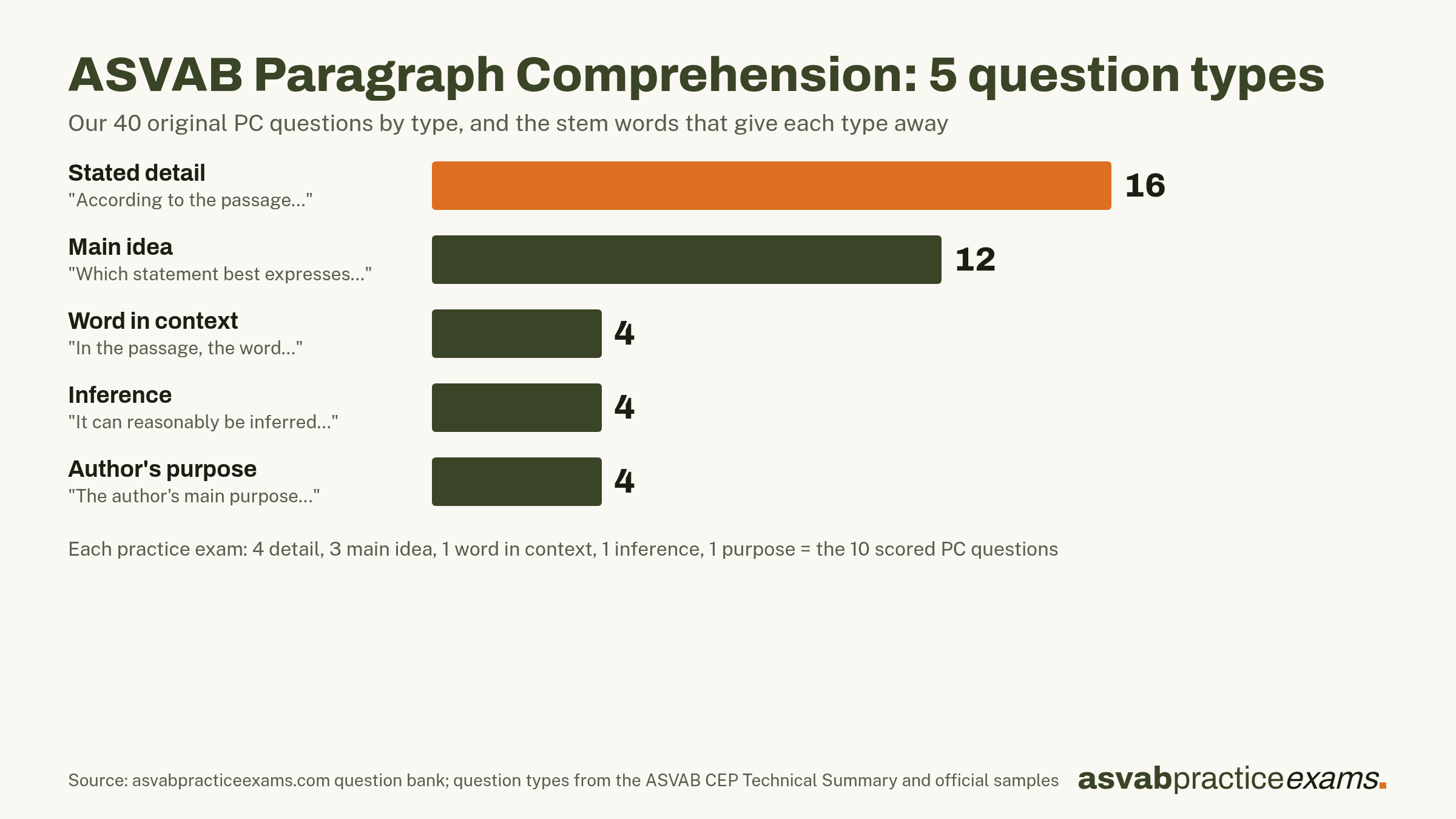
On the computer test, each question has its own short passage. Each of our 40 practice questions asks for one of five things: a stated detail, the main idea, a word’s meaning, an inference, or the author’s purpose. The wording of the question tells you which, and that tells you where in the passage the answer is. This guide shows the cue for each type, the traps in the wrong options, and three questions from our practice exams worked option by option.
What Paragraph Comprehension measures
The official description is the “ability to obtain information from written passages” (officialasvab.com). The ASVAB Career Exploration Program lists the concepts: stated and reworded facts, sequence of events, drawing conclusions, main ideas, the author’s purpose and tone, and style and technique. Passages are generally written for 10th graders (ASVAB CEP Technical Summary).
On the computer test, every question has its own passage. The questions were written that way on purpose, with “a single question per passage”, and the whole question appears on the screen at once (ASVAB Technical Bulletin No. 1). You never need to remember a passage from an earlier screen.
PC is one of the four AFQT subtests. It combines with Word Knowledge into the verbal score VE, and VE counts twice: AFQT = 2VE + AR + MK. Inside VE, PC carries about 0.62 of the weight of Word Knowledge (DMDC, 1997 ASVAB Score Scale). Our AFQT score guide walks through the formula.
The 5 question types and the words that give each away
We sorted all 40 original PC questions in our bank by type. The wording of the question signaled the type every time: all 12 main idea questions start “Which statement best expresses” or “Which statement best summarizes”, and all 4 word questions start “In the passage, the word”.
| Type | Our bank (of 40) | The question contains | Where the answer is | How to find it |
|---|---|---|---|---|
| Stated detail | 16 | "According to the passage (or notice, memo, instructions)..." | One sentence | Find the key word from the question in the passage. The answer rewords that sentence. |
| Main idea | 12 | "Which statement best expresses the main idea..." or "best summarizes..." | The whole passage | Ask what every sentence has in common. The answer covers all of them, not just one. |
| Word in context | 4 | "In the passage, the word ___ most nearly means" | The sentence around the word | Swap each option into that sentence. Keep the one that keeps the meaning. |
| Inference | 4 | "It can reasonably be inferred...", "Based on the passage...", "The passage suggests..." | Two or more sentences together | The answer is not written out. It must follow from what is written, with no outside facts. |
| Author's purpose | 4 | "The author's main (or primary) purpose in the passage is to..." or "The author most likely wrote this passage to" | The first sentence and the overall shape | Name what the passage does: explain, correct a belief, compare two sides, persuade. |
Each of our four practice exams has the same 10 PC questions by type: 4 detail, 3 main idea, 1 word in context, 1 inference and 1 author’s purpose. We built that mix from the official concept list above and the content specifications DoD published for earlier paper forms of the test (how the exams are built). The real test does not publish its current mix, so treat it as a close guide, not a promise.
Read the question before the passage. Five seconds on the question tells you whether to hunt for one sentence (detail, word) or think about the whole passage (main idea, inference, purpose). That saves rereading.
The four traps in the wrong answers
PC wrong answers come from a short list. The official samples on officialasvab.com show several of them, and the wrong options in our bank are written to the same patterns:
- True but not the answer. A real detail from the passage that does not answer this question. This is the main trap in main idea questions: the detail is right there, so it feels safe.
- Passage words, wrong meaning. The option reuses words from the passage but changes what they say, or joins two details that do not go together.
- The reverse. The option says the opposite of the passage, often by flipping one word.
- Sounds true in real life. A sensible fact or belief the passage never states. On the ASVAB, it is wrong if the passage does not support it.
Getting to the answer is often faster by elimination. Name the trap for each wrong option, and the option you cannot fault is the key.
Three questions from our practice exams, worked through
These questions appear in our practice exams. Try each one before reading the answer.
Main idea: from Practice Exam 1
On a summer afternoon, a city center can be several degrees warmer than the countryside a few miles away. Scientists call this the urban heat island effect. Dark roofs and pavement soak up sunlight during the day and release the heat slowly after sunset. Tall buildings block cooling breezes, and there are fewer trees to cool the air. Engines and air conditioners add still more heat. Some cities now paint roofs white and plant trees to reduce the effect.
Which statement best expresses the main idea of the passage?
A. Air conditioners are the main cause of city heat. · B. Painting roofs white is the best way to cool a city. · C. Cities are warmer than the countryside only at night. · D. Cities are hotter because of how they are built and used.
Answer: D. The passage names the effect, then lists four causes: pavement, buildings, few trees and machines. D is the only option that covers all of them.
- A is “passage words, wrong meaning”: air conditioners are one heat source, but the passage never calls any one the main cause.
- B turns a detail into a claim the passage does not make. White roofs are one step some cities take, not “the best way”.
- C is the reverse: the passage opens on a summer afternoon.
This question is in Practice Exam 1, Paragraph Comprehension.
Inference: from Practice Exam 1
Each year, a tree in a temperate climate adds a new layer of wood just under its bark. Wood formed in spring grows quickly and is pale, while wood formed later in summer grows slowly and is darker. One pale band and one dark band together make up a single annual ring. In years with plenty of rain, the rings tend to be wide, and during droughts they are narrow. By matching patterns of wide and narrow rings in living trees with those in old beams, scientists can date wooden objects and learn about past climates.
Based on the passage, a scientist who finds several very narrow rings in a row in an old beam would most likely conclude that the tree
A. was cut down in the spring. · B. grew during several very wet years. · C. was only a few years old when it was cut. · D. lived through several years with little rain.
Answer: D. Two sentences do the work together: one ring is one year, and rings are narrow during droughts. Several narrow rings in a row means several dry years.
- B is the reverse: rain makes rings wide, not narrow.
- C mixes up two ideas. The number of rings would show age, not their width, and several rings already means several years.
- A borrows “spring” from the passage, where it describes pale wood, not when the tree was cut.
This is the hardest kind of PC question, because the answer is never written out. Check it by asking: which sentences, taken together, force this conclusion? This question is in Practice Exam 1, Paragraph Comprehension.
Author’s purpose: from Practice Exam 2
Many people believe that cracking your knuckles causes arthritis. The popping sound comes from gas bubbles forming or collapsing in the fluid around the joints. Several studies comparing people who crack their knuckles with people who do not have found no difference in arthritis rates between the two groups. The habit may annoy the people around you, but there is little evidence that it leads to arthritis.
The author most likely wrote this passage to
A. explain how doctors treat arthritis. · B. correct a common belief about a habit. · C. describe the history of research on joints. · D. persuade readers to stop cracking their knuckles.
Answer: B. The first sentence states a belief, and the rest gives the evidence against it. That shape, “many people believe… but”, usually means the purpose is to correct a belief.
- D is the tempting one: the passage mentions the habit may annoy people, but it never asks anyone to stop.
- A and C pick up words from the passage (arthritis, studies) and build a purpose the passage does not have.
This question is in Practice Exam 2, Paragraph Comprehension.
How to use the 27 minutes
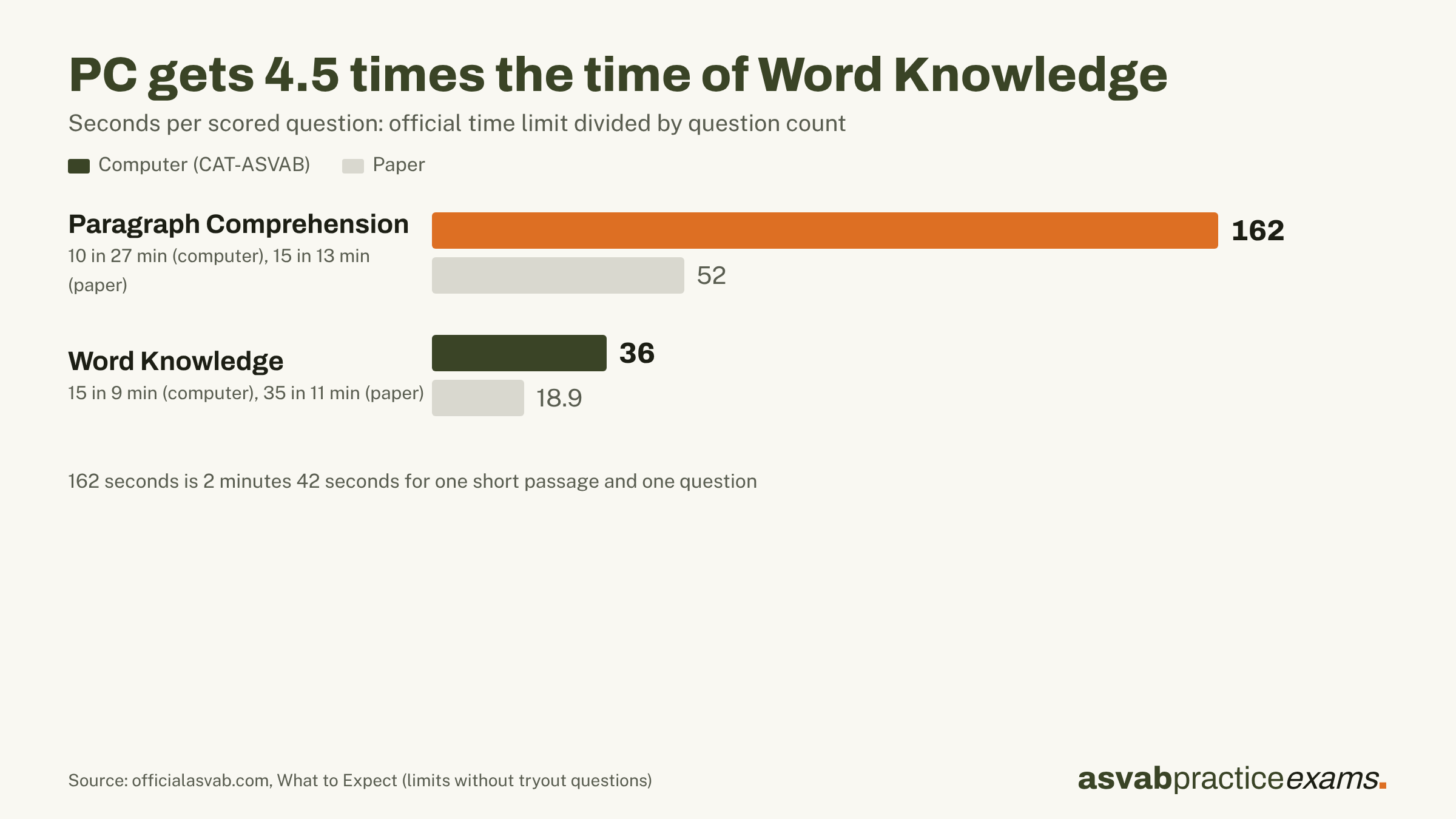
At 162 seconds a question, PC on the computer test gives you 4.5 times the time of Word Knowledge, which allows 36 (our arithmetic on the official limits). The time exists so you can check your answer against the passage. Use it in this order:
- Read the question first and name its type from the table above.
- Read the passage once, fully. Most passages are short.
- Find the support. For detail and word questions, point to the sentence. For main idea, purpose and inference, check your choice against the whole passage.
- Eliminate by trap. Give each wrong option a reason. If two options survive, reread the sentence that separates them.
The paper test is different: 52 seconds a question, so step 3 has to be quick. On either version, answer every question. On the computer test, questions you have not answered when time runs out are scored as though you had guessed at random (officialasvab.com). Our guide to how many questions are on the ASVAB has a clock check for every subtest.
Read NOT twice. Negative questions are uncommon in our bank (1 of 40), but 1 of the 4 official samples uses NOT, so expect to see one. Because they are uncommon, they are easy to misread. When a question says NOT, you are looking for the one option the passage does not support.
Practice Paragraph Comprehension at the real clock
Each of our four practice exams has the official 10 PC questions in 27 minutes, one question per screen, with an explanation for every answer choice.
- Start with a timed run of Practice Exam 1 with Study mode off, then review every PC question you missed by its type.
- Look for a pattern. If your misses cluster in main idea or inference, you are probably choosing true details that do not answer the question.
- Retake on a new set. Practice Exam 2, Practice Exam 3 and Practice Exam 4 share no questions with Exam 1 or with each other.
The AFQT-only mode runs just the four subtests that decide whether you can enlist. More short guides are on the study guide page.
Frequently asked questions
How many Paragraph Comprehension questions are on the ASVAB?
The computer ASVAB has 10 scored Paragraph Comprehension questions with a 27 minute limit, or 2 minutes 42 seconds per question. The paper ASVAB has 15 questions in 13 minutes. Some guides still say 11 questions in 22 minutes, which does not match the current official table.
Is Paragraph Comprehension part of the AFQT?
Yes. Paragraph Comprehension and Word Knowledge combine into a verbal score called VE, and VE counts twice in the AFQT formula, 2VE + AR + MK. Your Paragraph Comprehension score therefore affects whether you can enlist, not just which jobs you qualify for.
Can I use what I already know to answer Paragraph Comprehension questions?
No. Every correct answer is supported by the passage itself. A wrong option is often something that sounds true in real life but is not stated in the passage. If you cannot point to the sentence that supports your choice, keep looking.
Is the passage still on screen while I answer?
Yes. On the computer test, each question comes with its own short passage, and the whole question is shown on one screen. You can reread the passage as often as the clock allows.
How can I raise my Paragraph Comprehension score?
Read the question before the passage so you know its type, find the sentence that answers it, and rule out each wrong option by naming its flaw. Then practice under the real clock: 10 questions in 27 minutes.
Built and maintained by the ASVAB Practice Exams team. Every question is original, written to a subtest blueprint drawn from the official samples and DoD technical reports, and checked by a second reviewer who answers it without the key. About this site →