AFQT Score Explained: How It Is Calculated and What You Need to Enlist
Last updated: October 15, 2026
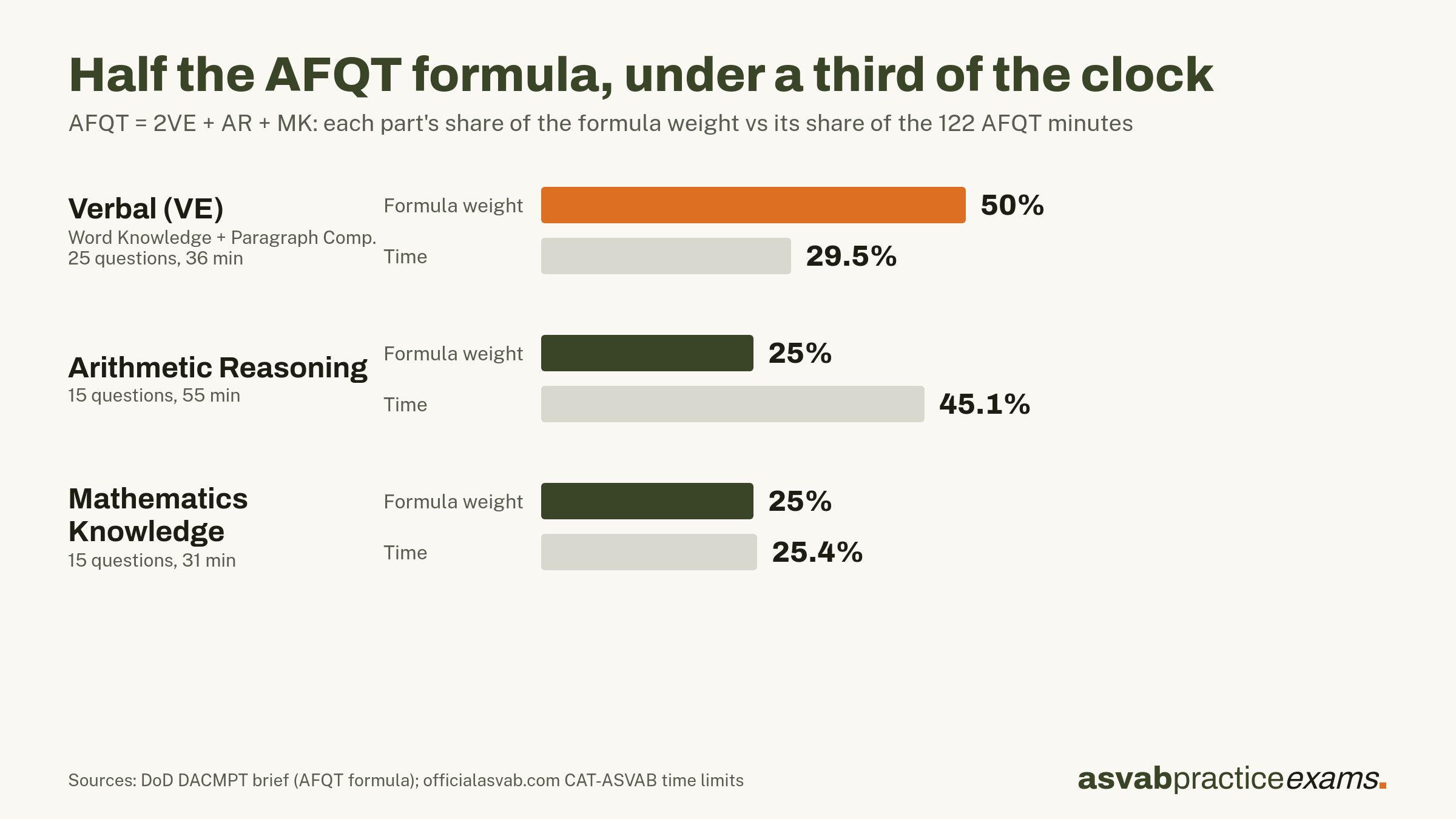
Your AFQT score is a percentile from 1 to 99 built from four ASVAB subtests with one formula: AFQT = 2VE + AR + MK. VE is a verbal score from Word Knowledge and Paragraph Comprehension, AR is Arithmetic Reasoning, and MK is Mathematics Knowledge. A score of 60 means you did as well as or better than 60% of a national sample of 18 to 23 year olds tested in 1997 (officialasvab.com).
That number decides whether you can enlist. This guide shows how it is put together, why the verbal half deserves more of your study time than the clock suggests, and which minimums are fixed in law versus set by each branch.
How the AFQT score is calculated
The Department of Defense’s own description of the formula (DACMPT brief, slide 21) has four parts:
- Each subtest gets a standard score. On the ASVAB scale the mean is 50 and the standard deviation is 10 (officialasvab.com).
- Word Knowledge and Paragraph Comprehension become VE. VE is an optimally weighted composite of the two unrounded standard scores. DoD’s 1997 score scale report gives the weighting: WK + 0.61934 × PC standard scores, restandardized to mean 50 and SD 10, so Paragraph Comprehension carries about two thirds the weight of Word Knowledge (DMDC, 1997 ASVAB Score Scale).
- The composite is 2 × VE + AR + MK. The verbal score counts twice.
- The composite becomes a percentile. It is compared with the 1997 national sample and reported from 1 to 99.
Raw scores are not added up. Some guides tell you to add your correct answers and look them up in a VE table. The computer ASVAB scores each subtest with an item response model that accounts for the difficulty of every question you answer, right or wrong, and converts the result to a standard score ([officialasvab.com](https://www.officialasvab.com/researchers/scores/)). The AFQT adds standard scores, not counts of correct answers.
A worked example of the weight
Because VE counts twice, the same improvement is worth twice as much there. Raise your verbal standard score by 5 points and the composite goes up 10. Raise Arithmetic Reasoning by 5 and it goes up 5. How many percentile points a 10-point gain buys depends on where you start (DoD’s conversion table is Table 2.5 of the same score scale report), but the direction is certain: verbal points are double points.
Where your AFQT minutes go
Each of the three parts gets its own share of the formula and its own share of the clock. We set the official CAT-ASVAB question counts and time limits (officialasvab.com) against the formula weights:
| Part | Questions | Minutes | Seconds per question | Share of formula weight | Share of AFQT time |
|---|---|---|---|---|---|
| Word Knowledge (VE) | 15 | 9 | 36 | 50% together | 29.5% together |
| Paragraph Comprehension (VE) | 10 | 27 | 162 | ||
| Arithmetic Reasoning | 15 | 55 | 220 | 25% | 45.1% |
| Mathematics Knowledge | 15 | 31 | 124 | 25% | 25.4% |
| AFQT total | 55 | 122 | 100% | 100% |
Half of the formula rides on 25 verbal questions answered in 36 minutes. Word Knowledge alone gives you 36 seconds a question, so you either know the word or you don’t, and there is no time to work it out on test day. That is why vocabulary has to be built in the weeks before the test.
Arithmetic Reasoning is the opposite: the most time, a quarter of the weight. Its 220 seconds a question are there because word problems take setup. Speed on it comes from practice with the common problem types, covered below.
Study in proportion to the weight, not the clock. If your verbal and math scores are close, an hour of vocabulary and reading practice is likely to move the AFQT more than an hour of algebra, because VE counts twice.
AFQT score categories
The services group AFQT percentiles into categories (officialasvab.com):
| Category | AFQT percentile | What it means for enlisting |
|---|---|---|
| I | 93 to 99 | Top band |
| II | 65 to 92 | Above average |
| IIIA | 50 to 64 | Average or above; with a diploma, DoD counts you as a high quality recruit |
| IIIB | 31 to 49 | Below average; 31 is the legal floor without a diploma |
| IVA, IVB, IVC | 21 to 30, 16 to 20, 10 to 15 | Limited by law to 4% of a service's enlistments a year (up to 20% with a Secretary of Defense waiver) |
| V | 1 to 9 | Not eligible to enlist |
The highest AFQT score is 99. A 50 is the middle of the reference group.
What the law sets, and what each branch sets
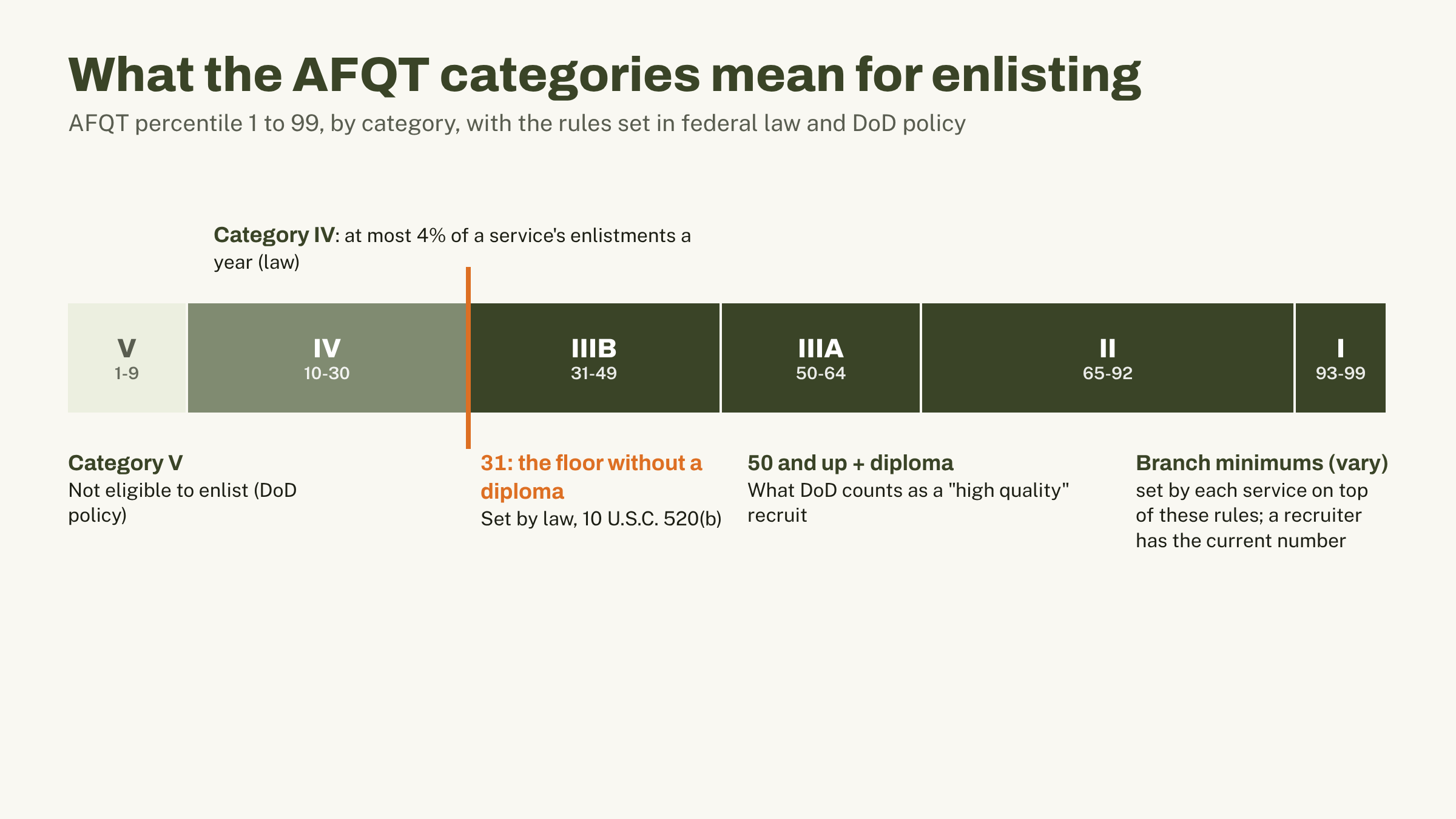
A few rules are the same for every branch, because they come from federal law or Defense Department policy:
- No diploma, no enlistment below 31. A person without a high school diploma may not enlist unless their AFQT is at or above the 31st percentile (10 U.S.C. 520(b)). The law allows an exception when a service needs the enlistment to meet its strength.
- Category IV is capped. Recruits scoring from the 10th to the 30th percentile may be no more than 4% of a service’s original enlistments in a fiscal year. The Secretary of Defense can raise the cap to 20% at a service’s request (10 U.S.C. 520(a)).
- Category V is out. Defense Department policy makes anyone scoring from 1 to 9 ineligible (Congressional Research Service, IF11147, January 2026).
- The benchmarks. DoD wants at least 90% of new recruits to hold a high school diploma and at least 60% to score above average on the AFQT (same CRS report).
Above that floor, each service prescribes its own aptitude and education criteria for eligibility (DoD, Population Representation in the Military Services, FY1998). That is why lists of branch minimums online disagree with each other: the number is a service policy, not a fixed rule in law, and it is not the same for every credential. Your recruiter has the current minimum for your branch and your education credential.
Aim above the minimum. The AFQT decides whether you can enlist. Which jobs open up depends on line scores, the composites each service builds from the subtests. The Navy has 29 of them, the Air Force and Marine Corps 4 (DACMPT brief, slide 22).
Worked questions from our practice exams
Three questions from the AFQT subtests, one from each part of the formula, taken from our free practice exams. Each one shows a trap that costs points on test day.
Arithmetic Reasoning: the average trap
A student’s average score on 4 tests is 82. What score does the student need on the fifth test to raise the average to 84?
A. 84 · B. 86 · C. 90 · D. 92
Answer: D. An 84 average on 5 tests needs 5 × 84 = 420 points. The first 4 tests total 4 × 82 = 328, so the fifth must be 420 − 328 = 92. The trap is B: adding 2 points once forgets that the fifth test must make up 2 points for each of the 4 earlier tests too. Working with totals instead of averages gets you out of it every time.
This question is in Practice Exam 1, Arithmetic Reasoning.
Word Knowledge: a word in a sentence
The mayor tried to alleviate concerns about the new tax. The underlined word most nearly means:
A. ease · B. raise · C. ignore · D. explain
Answer: A. To alleviate is to make a worry or pain less severe. D is the trap: the mayor might well explain the tax, and it fits the sentence, but explain does not mean lessen. On in-context items, pick the word that could replace the underlined one without changing the meaning, not the one that just makes sense in the sentence.
This question is in Practice Exam 2, Word Knowledge. Our three exams carry 45 Word Knowledge questions in all, 27 stand-alone synonyms and 18 words in a sentence.
Mathematics Knowledge: order of operations
18 − 6 ÷ 3 × 2 =
A. 2 · B. 8 · C. 14 · D. 17
Answer: C. Division and multiplication come before subtraction, left to right: 6 ÷ 3 = 2, then 2 × 2 = 4, and 18 − 4 = 14. B subtracts first. D multiplies before dividing. With no calculator on the ASVAB, write each step on your scratch paper.
This question is in Practice Exam 1, Mathematics Knowledge.
How to estimate and raise your AFQT score
- Take a timed AFQT run first. Each of our three exams has an AFQT-only mode with the four subtests at their real time limits, 55 questions in up to 122 minutes, and ends with an estimated percentile. How that estimate is made, and where it is weaker than the real test, is written up in full.
- Use all three exams to track progress. Practice Exam 2 and Practice Exam 3 share no questions with Exam 1 and have the same topic mix and a near-identical difficulty spread, so a change in your score reflects you, not the questions.
- Fix verbal first if the gap is close. The formula counts it twice.
- Answer everything. On the computer ASVAB, questions left unanswered when time runs out are scored as random guesses, with a penalty that grows with the number left (officialasvab.com).
- Ask about the APT. Recruiters can give a short, unproctored AFQT Predictor Test: 20 adaptive questions from the same four subtests, about 20 to 30 minutes, that predicts your AFQT but does not guarantee it (officialasvab.com).
Your scores stay valid for enlistment for two years. If you need a higher number, you can retest after one calendar month; after a second retest the wait is six calendar months (officialasvab.com FAQ).
More topic guides are on the study guide page.
Frequently asked questions
What is a good AFQT score?
A 50 is the middle of the 1997 reference group of 18 to 23 year olds, and the Department of Defense counts a recruit with a 50 or higher and a high school diploma as high quality. A 65 to 92 puts you in Category II, and 93 or higher in Category I. What counts as good for you depends on the branch and the job you want.
What is the highest AFQT score?
99. The AFQT is reported as a percentile from 1 to 99, so a 99 means you scored as well as or better than 99% of the reference group. Category I covers 93 to 99.
Is the AFQT score the same as the ASVAB score?
It is the score most people mean. The ASVAB itself has no single overall score: you get a standard score for each subtest, the AFQT percentile from four of them, and line scores (composites) that each service uses to qualify you for jobs.
Which ASVAB subtests count toward the AFQT?
Four: Arithmetic Reasoning, Mathematics Knowledge, Word Knowledge and Paragraph Comprehension. Word Knowledge and Paragraph Comprehension combine into a verbal score (VE) that counts twice in the formula.
How long is an AFQT score good for, and can I retake it?
Your scores can be used for enlistment for up to two years from the test date. You wait one calendar month before a first retest, and after a second retest you wait six calendar months before testing again.
Built and maintained by the ASVAB Practice Exams team. Every question is original, written to a subtest blueprint drawn from the official samples and DoD technical reports, and checked by a second reviewer who answers it without the key. About this site →