What Is a Good ASVAB Score? Score Ranges, the Average and the Highest Possible
Last updated: November 22, 2026
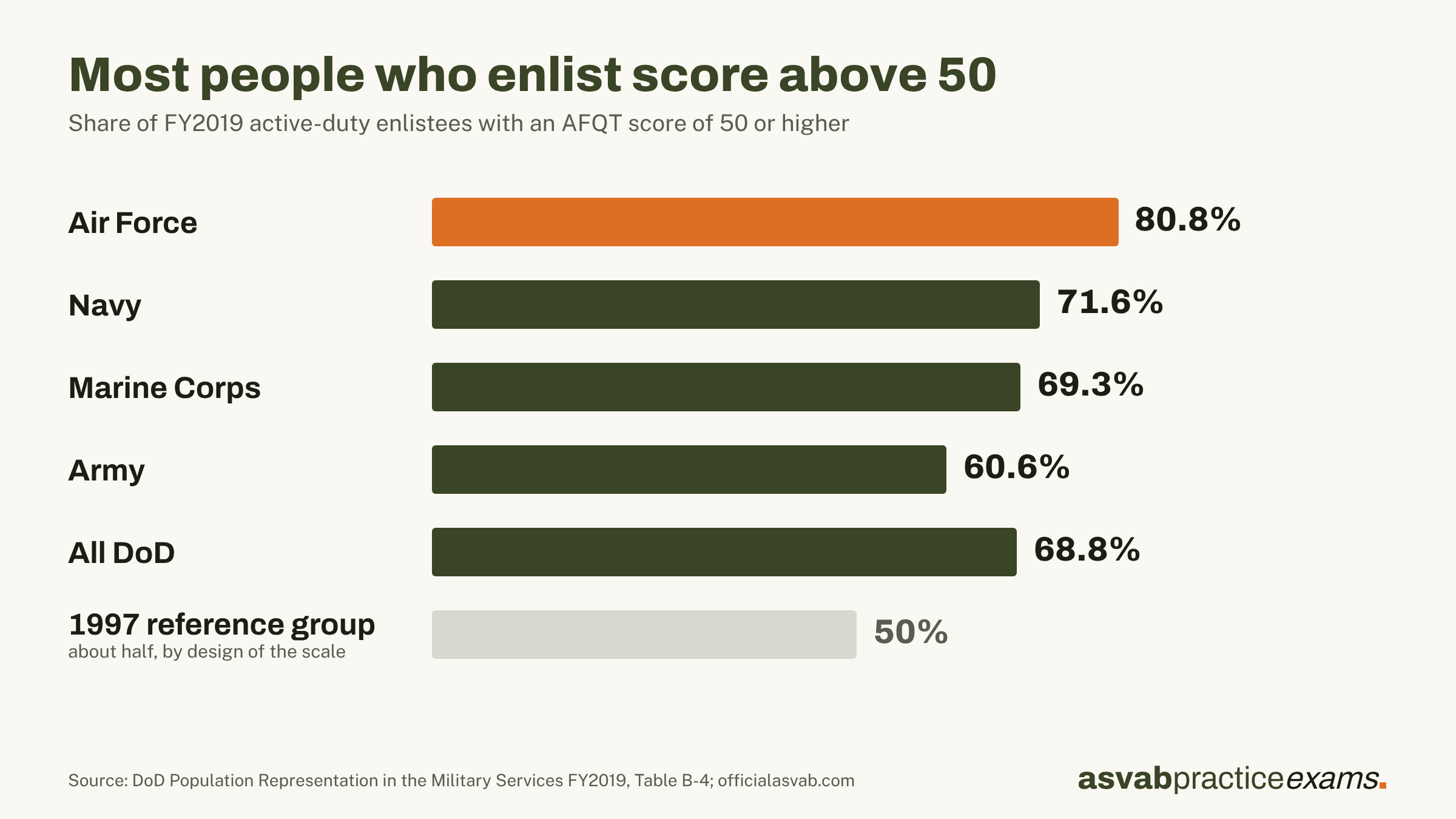
A good ASVAB score is an AFQT of 50 or higher: the middle of the national reference group, and with a high school diploma the line for what the Defense Department calls a high quality recruit. The minimum to enlist with a diploma is 31 in the Army, Navy, Air Force and Marine Corps. The highest possible AFQT is 99 (officialasvab.com).
That answer hides two things most guides skip. “ASVAB score” can mean three different numbers, and the people who actually enlist score well above 50. In fiscal year 2019, 68.8% of new active-duty enlistees had an AFQT of 50 or more (DoD Population Representation, FY2019, Table B-4). This guide sorts out the three scores, then defines “good” by what you want the score to do.
The three kinds of ASVAB score
Your score sheet carries three kinds of number. Each has its own scale, so each has its own average and its own top.
| Score | What it is | Scale | Average | Highest |
|---|---|---|---|---|
| Subtest standard scores | One per subtest, such as Arithmetic Reasoning or General Science | Mean 50, standard deviation 10 | 50 | No fixed top; 70 is two standard deviations above average |
| AFQT | From four subtests; decides whether you can enlist | Percentile, 1 to 99 | 50 | 99 |
| Line scores (composites) | Combinations of subtests; decide which jobs are open | Depends on the service | Depends on the service | Air Force: 99 |
Sources: officialasvab.com scoring, airforce.com.
Subtest standard scores
Each subtest is scored on a scale where the average is 50 and one standard deviation is 10 points. About half of the reference group scores 50 or more, and about 16% scores 60 or more (officialasvab.com). So a 60 on a subtest is already a strong score, and a 70 is two standard deviations above the average.
The AFQT percentile
The AFQT is the score people usually mean. It is built from Arithmetic Reasoning, Mathematics Knowledge, Word Knowledge and Paragraph Comprehension, and it is reported as a percentile from 1 to 99. A 62 means you scored as well as or better than 62% of a national sample of 18 to 23 year olds tested in 1997 (officialasvab.com FAQ). It is not a percent of questions right: a 70 does not mean you got 70% of the questions. The formula and why the verbal half counts twice are in our AFQT score guide.
Line scores
Line scores use a different scale in each service, so the same number means different things:
- Navy composites are plain sums of standard scores. The General Technician composite is AR + VE, two scores that each average 50, so the reference group averages 100 on it. A Navy Diver needs AR + VE = 103 and MC = 51 (navy.com): just above that average on both.
- Air Force composites are percentiles from 1 to 99 (airforce.com). Electrical Systems asks for 43 Mechanical and 45 Electronics (airforce.com).
Every formula for every branch is in ASVAB line scores explained.
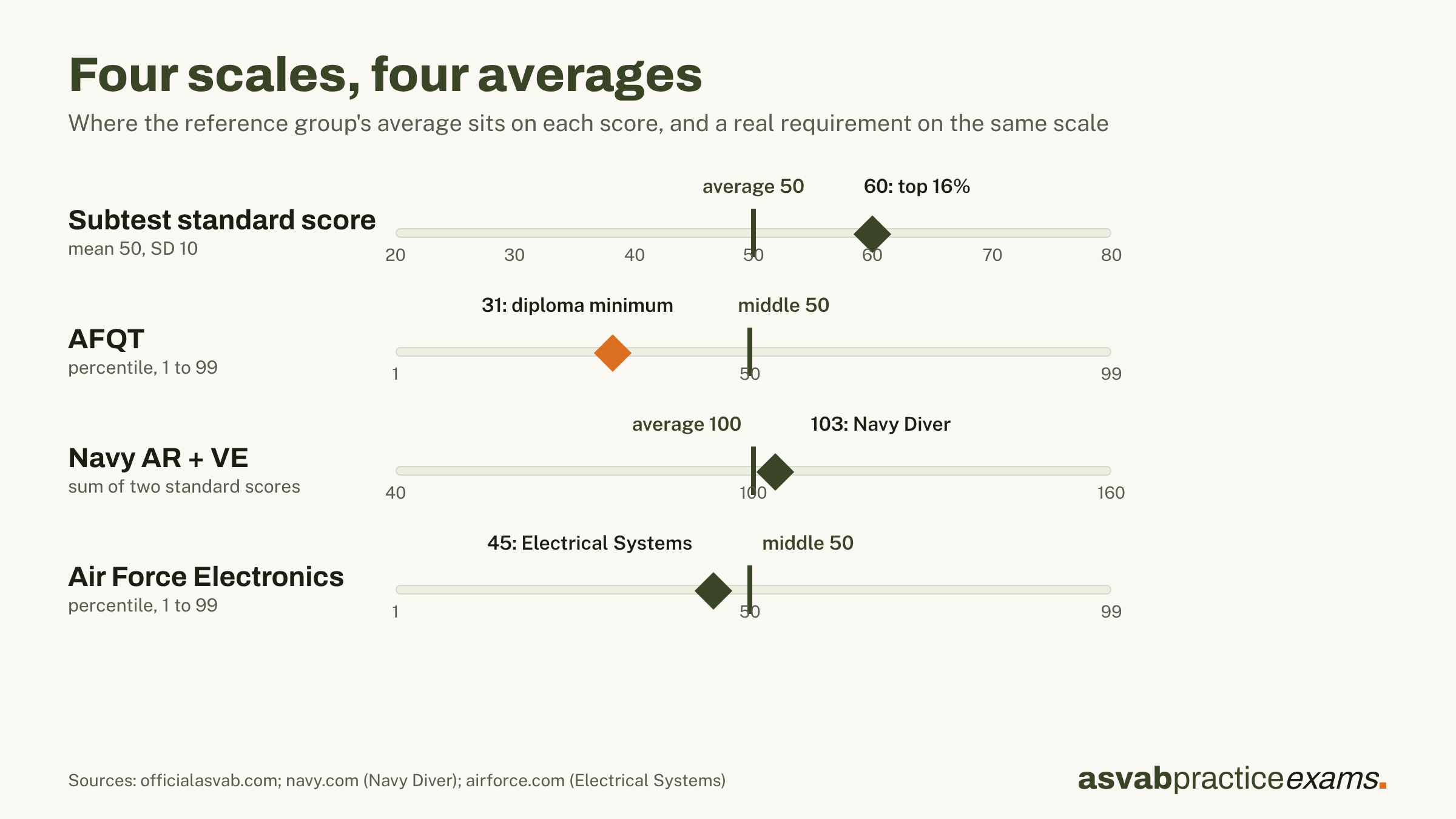
A composite number is not an AFQT number. A Navy AR + VE score of 103 is barely above average. An AFQT of 103 does not exist. Before you compare your score to a number online, check which of the three scores it is.
What a good AFQT score is, by goal
“Good” depends on what you need the score to do. Each row below is a line set by law, by the Defense Department or by a service, from that source’s current page or manual:
| AFQT | What it does | Source |
|---|---|---|
| 1 to 9 | Category V: not eligible to enlist | DoD Population Representation, Table B-4 |
| 21 | Army: the floor for the academic track of the Future Soldier Preparatory Course, a 90-day course with chances to retest | goarmy.com |
| 31 | Minimum to enlist with a high school diploma: Army, Navy, Air Force and Marine Corps. Without a diploma, federal law sets 31 as the floor | goarmy.com, Navy Recruiting Manual, para. 020702, airforce.com, marines.com, 10 U.S.C. 520 |
| 50 | Minimum with a GED: Air Force, Marine Corps (also nontraditional diplomas) and Navy (all Tier 2 applicants). With a diploma, 50 and up is a high quality recruit | airforce.com, marines.com, Navy Recruiting Manual, para. 020503, DoD Population Representation FY2019 summary |
| 65 | Air Force: minimum for applicants with no diploma or alternate credential. Also the start of Category II | airforce.com, officialasvab.com |
| 93 | Category I, the top band | officialasvab.com |
The Navy manual cited is COMNAVCRUITCOMINST 1130.8S, dated 5 August 2026. It also says an applicant scoring below 50 must be a Tier 1 high school diploma graduate. Some search results list minimums of 35 or 36 for the Navy, 36 for the Air Force or 35 for the Marine Corps. The services’ own current pages and manual all say 31 with a diploma. Minimums do change, so confirm yours with a recruiter.
Aim for 50, not 31. A 31 gets a diploma holder in the door. A 50 covers the GED rule in three services, makes you a high quality recruit, and puts you where most enlistees already are. The jobs you can pick then depend on your line scores.
What people who enlist actually score
A 50 is the middle of everyone in the 1997 sample, including people who never planned to enlist. The people who do enlist score higher. The Defense Department’s Population Representation report counts every new active-duty enlistee by AFQT category. In fiscal year 2019 (Table B-4):
| Service | Category I (93 to 99) | II (65 to 92) | IIIA (50 to 64) | IIIB (31 to 49) | IV (10 to 30) | 50 or higher |
|---|---|---|---|---|---|---|
| Army | 5.5% | 31.2% | 23.9% | 37.3% | 2.0% | 60.6% |
| Navy | 8.3% | 38.9% | 24.4% | 28.3% | 0.0% | 71.6% |
| Marine Corps | 4.6% | 36.8% | 27.9% | 30.7% | 0.0% | 69.3% |
| Air Force | 7.8% | 46.2% | 26.9% | 17.9% | 0.0% | 80.8% |
| All DoD | 6.4% | 37.0% | 25.4% | 30.2% | 0.8% | 68.8% |
Non-prior-service active-duty enlistees. Rows can miss 100% because the report also has a small “unknown” column (1.3% for the Air Force) and the values are rounded. A 0.0% in Category IV means 2 or fewer people.
Three things stand out:
- Category II is the biggest group. More than a third of all enlistees scored from 65 to 92.
- The Air Force is the hardest place to be average. Four out of five of its 2019 enlistees scored 50 or more, and fewer than 1 in 5 scored from 31 to 49.
- Below 31 almost never happens. Under 1% of enlistees were in Category IV. Federal law now caps Category IV at 4% of a service’s enlistments, and the Secretary of Defense can raise that to 20% (10 U.S.C. 520).
Is my score good? Quick answers
- 25: Below the diploma minimum of 31. In the Army, a score of 21 or more can qualify you for the academic track of the Future Soldier Preparatory Course (goarmy.com). Otherwise, retest.
- 32 or 37: Enough to enlist with a diploma in all four services, but Category IIIB. With a GED, you need 50 in the Navy, Air Force and Marine Corps.
- 50 to 64: Category IIIA. Meets every diploma and GED minimum above, and the high quality line with a diploma.
- 70: Category II. You scored as well as or better than 70% of the reference group. Category II was the largest group of 2019 enlistees.
- 93 or more: Category I, the top band. The highest score is 99.
Two questions from our practice exams
Two AFQT questions, each with the trap that costs points. Both are from our free practice exams.
Arithmetic Reasoning: averaging two averages
One class of 20 students averaged 76 points on a test. Another class of 30 students averaged 86 points on the same test. What was the average score for all 50 students?
A. 80 · B. 81 · C. 82 · D. 162
Answer: C. Turn each average back into a total. 20 × 76 = 1,520 and 30 × 86 = 2,580, so the two classes scored 4,100 points. 4,100 ÷ 50 = 82. The trap is B: 81 is halfway between 76 and 86, which would only be right if the classes were the same size. The bigger class had the higher average, so the answer leans toward 86.
This question is in Practice Exam 4, Arithmetic Reasoning. Every word problem in our bank is also on the Arithmetic Reasoning practice test, grouped by type.
Word Knowledge: a word in a sentence
The inspector gave the contract a perfunctory review. The underlined word most nearly means:
A. harshly critical · B. slow and thorough · C. hasty and careless · D. officially approved
Answer: C. A perfunctory review is done quickly and with little care, just to get it over with. D is the trap: a review can end in approval, and the sentence still makes sense, but perfunctory describes how the review was done, not how it ended.
This question is in Practice Exam 3, Word Knowledge.
How to find out where you stand
- Take one full exam under the clock. Each of our four practice exams ends with an estimated AFQT percentile. How the estimate is made, and where it is weaker than the real test, is written up in full. Start with Practice Exam 1.
- Set your target from the goal table. Know your credential and your branch, then aim at the 50 line or above.
- Check the job you want. Your line scores, not your AFQT, decide that. Find its composites in ASVAB line scores explained.
- Know the clock. The four AFQT subtests are 55 scored questions with time limits that add up to 122 minutes on the computer test (longer if tryout questions appear); the full counts are in how many questions are on the ASVAB.
- Know the retest rule. After your first test you wait one calendar month, then another month, then six months before each retest after that. Scores can be used for enlistment for two years (officialasvab.com FAQ). The Army counts your most recent score, not your highest (goarmy.com).
More guides on scores and subtests are on the study guide page.
Frequently asked questions
What is a good ASVAB score?
For most people, an AFQT of 50 or higher. That puts you at or above the middle of the national reference group, and with a high school diploma it makes you what the Department of Defense calls a high quality recruit. A 31 is the minimum to enlist with a diploma in the Army, Navy, Air Force and Marine Corps, and a 65 or higher is Category II or better.
What is the average ASVAB score?
On the AFQT, 50 is the middle of the 1997 reference group of 18 to 23 year olds, and each subtest standard score is set to an average of 50. People who actually enlist score higher: in fiscal year 2019, 68.8% of new active-duty enlistees had an AFQT of 50 or more, per the Defense Department's Population Representation report.
What is the highest ASVAB score?
The highest AFQT score is 99, because it is a percentile from 1 to 99. Air Force composite scores are also percentiles, so their top is 99 too. Subtest standard scores and Navy composite sums have no single published maximum; a subtest standard score of 70 is already two standard deviations above the average.
Is 31 a good ASVAB score?
It is enough to enlist with a high school diploma in all four of these services, but it is the lowest qualifying score and the bottom of Category IIIB. With a GED you need a 50 in the Navy, Air Force and Marine Corps. Most people who enlist score well above 31.
Do I need a higher ASVAB score with a GED?
Yes, in most services. The Air Force and the Marine Corps ask for a 50 with a GED, and the Navy's recruiting manual requires a 50 for every Tier 2 applicant, the education tier that includes the GED. Without any diploma or credential, the Navy also requires a 50 and the Air Force a 65.
Built and maintained by the ASVAB Practice Exams team. Every question is original, written to a subtest blueprint drawn from the official samples and DoD technical reports, and checked by a second reviewer who answers it without the key. About this site →