ASVAB Line Scores Explained: Every Composite by Branch and What It Qualifies You For
Last updated: November 12, 2026
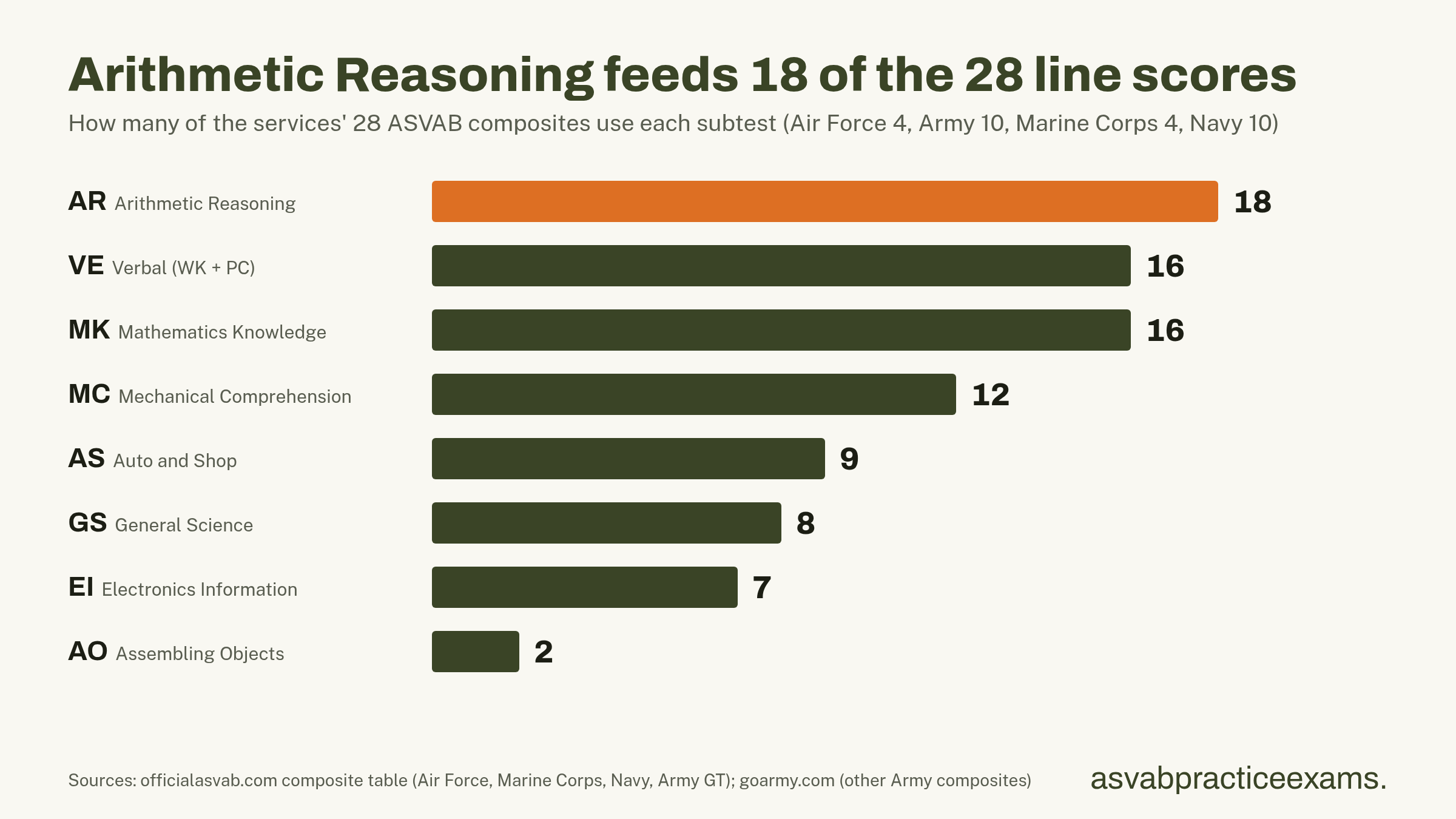
ASVAB line scores are composites: each service adds up (or weights) your subtest standard scores into job-area scores, and every military job has a minimum on one or more of them. The official ASVAB program lists 28 composites in all, 4 for the Air Force, 10 for the Army, 4 for the Marine Corps and 10 for the Navy (officialasvab.com).
Your AFQT score decides whether you can enlist. Line scores decide which jobs are open to you once you can. This guide gives every formula from the official table, shows how to work them out from your score sheet, and shows which subtests to practice for the composites your job needs.
What a line score is, and how it differs from the AFQT
Every ASVAB subtest gets a standard score, where 50 is the average of the reference group and 10 points is one standard deviation (officialasvab.com). The AFQT uses four of them. Line scores can use all of them.
Each service builds its own set. In the official wording, each service “develops and validates its own set of composites” from the subtests most closely tied to job performance in a group of occupations (officialasvab.com). So the Army’s General Technical and the Navy’s General Technician share the initials GT and the same formula, but most composites exist in only one branch.
The codes used in every formula below:
| Code | Subtest | In the AFQT? |
|---|---|---|
| VE | Verbal: Word Knowledge and Paragraph Comprehension combined | Yes (counts twice, see the AFQT formula) |
| AR | Arithmetic Reasoning | Yes |
| MK | Mathematics Knowledge | Yes |
| GS | General Science | No |
| EI | Electronics Information | No |
| AS | Auto and Shop Information (two subtests on the computer ASVAB, reported as one score) | No |
| MC | Mechanical Comprehension | No |
| AO | Assembling Objects | No |
VE is not a simple sum of Word Knowledge and Paragraph Comprehension. It is a weighted composite of the two unrounded standard scores, put back on the same 50-and-10 scale (officialasvab.com).
Air Force line scores: the MAGE composites
The Air Force uses four composites, known by their initials as MAGE (airforce.com):
| Composite | Formula |
|---|---|
| Mechanical (M) | AR + 2VE + MC + AS |
| Administrative (A) | VE + MK |
| General (G) | VE + AR |
| Electronic (E) | AR + MK + EI + GS |
Formulas from the official composite table. The Air Force reports each MAGE score as a percentile from 1 to 99, not as the raw sum (airforce.com). Each career lists its own minimums. Electrical Systems (3E0X1), for example, asks for 43 Mechanical and 45 Electronics (airforce.com).
The Mechanical score counts your verbal score twice. In the official formula, VE carries more weight in Mechanical than Mechanical Comprehension or Auto and Shop do. Many prep guides leave verbal out of it altogether. If you want an Air Force mechanical job, reading and vocabulary practice pays off twice: once in the AFQT and again in M.
Army line scores: GT and nine weighted composites
The Army uses ten composites. Only one of them is a plain sum: General Technical (GT) = AR + VE. The other nine are each “computed as a non-integer weighted linear combination of all ASVAB subtests” (GS, AR, WK, PC, MK, EI, AS, MC and AO), per the official composite table.
That means every subtest moves every Army composite a little. The Army does say which subtests each composite leans on most, with an example job for each (goarmy.com):
| Composite | Leans most on | Example job (MOS) |
|---|---|---|
| General Technical (GT) | VE, AR (the whole formula) | Stryker Systems Maintainer (91S) |
| Clerical (CL) | VE, AR, MK | Human Resources Specialist (42A) |
| Combat (CO) | VE, AS, MC | Infantryman (11B) |
| Electronics (EL) | GS, AR, MK, EI | Radar Repairer (94M) |
| Field Artillery (FA) | AR, MK, MC | Field Artillery Recruit (13U) |
| General Maintenance (GM) | GS, AS, MK, EI | Parachute Rigger (92R) |
| Mechanical Maintenance (MM) | AS, MC, EI | Self-Propelled Artillery Systems Mechanic (91P) |
| Operators and Food (OF) | VE, AS, MC | Culinary Specialist (92G) |
| Surveillance and Communication (SC) | VE, AR, AS, MC | Electronic Warfare Specialist (17E) |
| Skilled Technical (ST) | GS, VE, MC, MK | Ammunition Specialist (89B) |
You can't add up your own Army CL or EL score. Many websites print the nine Army composites as simple sums, such as CL = VE + AR + MK. The official table says they are weighted over all nine subtests, and the weights are not in it. Use the "leans most on" column to decide what to study. Your score report or your recruiter has the actual composite scores.
Marine Corps line scores
The Marine Corps uses four composites (officialasvab.com):
| Composite | Formula |
|---|---|
| Mechanical (MM) | AR + MC + AS + EI |
| Clerical (CL) | VE + MK |
| General Technician (GT) | VE + AR + MC |
| Electrical (EL) | AR + MK + EI + GS |
The Marine GT is not the Army GT. It adds Mechanical Comprehension to VE and AR, so MC practice raises a Marine’s GT score.
Navy line scores
The Navy has the longest list, and every one of its ten composites is a plain sum of standard scores (officialasvab.com). Each standard score averages 50, so a two-part Navy composite averages 100 in the reference group, and what is a good ASVAB score sets that average against a real job minimum. The ten formulas:
| Composite | Formula |
|---|---|
| General Technician | VE + AR |
| Electronics | GS + AR + MK + EI |
| Basic Electricity and Electronics | GS + AR + 2MK |
| Engineering | AS + MK |
| Mechanical (1) | AR + AS + MC |
| Mechanical (2) | AR + MC + AO |
| Nuclear | VE + AR + MK + MC |
| Operations | VE + AR + MK + AO |
| Hospitalman | VE + GS + MK |
| Administrative | VE + MK |
Assembling Objects shows up in only two composites across all four services, Navy Mechanical (2) and Operations, plus whatever weight it carries inside the Army’s nine weighted composites.
Which subtests feed the most line scores
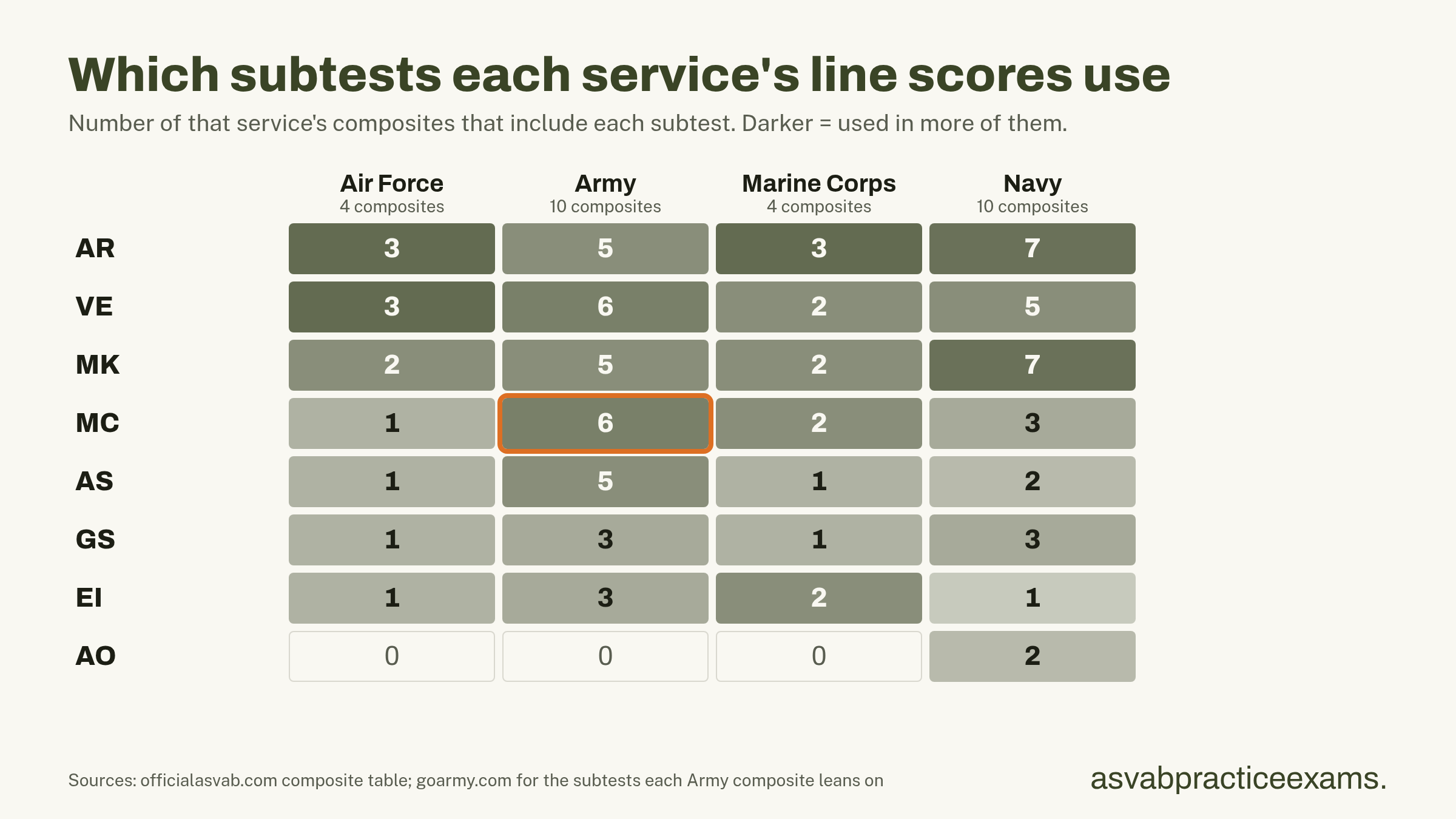
We counted how many of the 28 composites use each subtest. For the Army’s nine weighted composites we counted the subtests goarmy.com says each leans on. A subtest counts once per composite, even where the formula doubles it:
| Subtest | Composites (of 28) | Air Force | Army | Marine Corps | Navy |
|---|---|---|---|---|---|
| Arithmetic Reasoning (AR) | 18 | 3 | 5 | 3 | 7 |
| Verbal (VE) | 16 | 3 | 6 | 2 | 5 |
| Mathematics Knowledge (MK) | 16 | 2 | 5 | 2 | 7 |
| Mechanical Comprehension (MC) | 12 | 1 | 6 | 2 | 3 |
| Auto and Shop (AS) | 9 | 1 | 5 | 1 | 2 |
| General Science (GS) | 8 | 1 | 3 | 1 | 3 |
| Electronics Information (EI) | 7 | 1 | 3 | 2 | 1 |
| Assembling Objects (AO) | 2 | 0 | 0 | 0 | 2 |
Two things stand out. The three AFQT parts (AR, VE and MK) are also the backbone of the line scores, so AFQT study is never wasted. And Mechanical Comprehension, which the AFQT ignores, feeds 12 composites, including 6 of the Army’s 10. Arithmetic Reasoning tops the list, so it is the single best subtest to drill; our Arithmetic Reasoning practice test has every AR question in our bank, grouped by problem type.
A worked example: one score sheet, every line score
Say your standard scores come back as VE 56, AR 52, MK 48, GS 50, EI 46, AS 44, MC 54 and AO 50. Here is every summed composite in the official table, all 19 of them:
| Service | Composite | Working | Sum | 50-per-term mark |
|---|---|---|---|---|
| Air Force | Mechanical | 52 + 2 × 56 + 54 + 44 | 262 | 250 |
| Air Force | Administrative | 56 + 48 | 104 | 100 |
| Air Force | General | 56 + 52 | 108 | 100 |
| Air Force | Electronic | 52 + 48 + 46 + 50 | 196 | 200 |
| Army | General Technical | 52 + 56 | 108 | 100 |
| Marine Corps | Mechanical | 52 + 54 + 44 + 46 | 196 | 200 |
| Marine Corps | Clerical | 56 + 48 | 104 | 100 |
| Marine Corps | General Technician | 56 + 52 + 54 | 162 | 150 |
| Marine Corps | Electrical | 52 + 48 + 46 + 50 | 196 | 200 |
| Navy | General Technician | 56 + 52 | 108 | 100 |
| Navy | Electronics | 50 + 52 + 48 + 46 | 196 | 200 |
| Navy | Nuclear | 56 + 52 + 48 + 54 | 210 | 200 |
| Navy | Basic Electricity and Electronics | 50 + 52 + 2 × 48 | 198 | 200 |
| Navy | Engineering | 44 + 48 | 92 | 100 |
| Navy | Mechanical (1) | 52 + 44 + 54 | 150 | 150 |
| Navy | Mechanical (2) | 52 + 54 + 50 | 156 | 150 |
| Navy | Operations | 56 + 52 + 48 + 50 | 206 | 200 |
| Navy | Hospitalman | 56 + 50 + 48 | 154 | 150 |
| Navy | Administrative | 56 + 48 | 104 | 100 |
The last column is a quick way to read a sum: multiply 50 by the number of terms in the formula (a doubled subtest counts twice). A sum above that mark means the subtests in it average better than the reference group’s mean. This applicant clears the mark wherever VE is in the sum and falls short on six: Air Force Electronic, Marine Corps Mechanical and Electrical, and Navy Electronics, Basic Electricity and Electronics, and Engineering. EI, AS and MK, the three subtests below 50, pull those sums down (MK counts twice in Basic Electricity and Electronics), so those three are the study plan.
Each service turns these sums into its own reporting scale and job minimums. The Air Force reports MAGE as percentiles, for example. Use the sums to see where you are strong or weak, and get the current minimum for a specific job from that service or your recruiter.
Worked questions from the subtests only line scores use
Five subtests never touch your AFQT but feed line scores: General Science, Electronics Information, Auto and Shop, Mechanical Comprehension and Assembling Objects. Between them, our four practice exams carry 60 questions each of General Science, Electronics Information, Mechanical Comprehension and Assembling Objects, and 80 Auto and Shop questions (40 auto, 40 shop). Here are three of them, and if General Science is the one your target composite needs, our General Science practice test puts every science question in our bank on one page, grouped by topic.
Electronics Information: Ohm’s law upside down
A toaster draws 10 amperes from a 120-volt outlet. What is its resistance?
A. 0.083 Ω · B. 12 Ω · C. 110 Ω · D. 1,200 Ω
Answer: B. Resistance is voltage divided by current: R = V ÷ I = 120 ÷ 10 = 12 Ω. A divides the other way round (10 ÷ 120). D multiplies volts by amps, which gives power in watts, not resistance. Write V = I × R on your scratch paper and solve for the letter the question asks about.
This question is in Practice Exam 1, Electronics Information. EI counts in the Air Force Electronic, Marine Corps Mechanical and Electrical, Navy Electronics, and the Army composites that lean on it most, EL, GM and MM.
Mechanical Comprehension: which sprocket turns faster
A bicycle’s front sprocket has 48 teeth and its rear sprocket has 16 teeth. The rider turns the pedals at 60 rpm. How fast does the rear wheel turn?
A. 20 rpm · B. 60 rpm · C. 120 rpm · D. 180 rpm
Answer: D. One turn of the pedals pulls 48 teeth of chain, enough to turn the 16-tooth sprocket 48 ÷ 16 = 3 times. So 60 × 3 = 180 rpm. A divides when it should multiply: the smaller sprocket always turns faster. B assumes the chain makes both sprockets turn at the same speed.
This question is in Practice Exam 4, Mechanical Comprehension. MC feeds 12 of the 28 composites, including the Marine GT. Our Mechanical Comprehension guide shows the four rules that solve most MC questions, this sprocket rule among them.
Auto Information: the tool that measures
A repair manual says the cylinder head bolts must be tightened to 65 ft·lb. Which tool lets a mechanic tighten them to that specified value?
A. Impact wrench · B. Torque wrench · C. Breaker bar · D. Box-end wrench
Answer: B. A torque wrench reads or clicks at a set twisting force. The trap is A: an impact wrench tightens fast but measures nothing, so it easily overtightens. C and D give leverage or grip, not a reading. When a question names a number, look for the tool that measures it.
This question is in Practice Exam 4, Auto Information. Auto and Shop feeds 9 composites, five of them Army.
How to raise the line scores your job needs
- Find your job’s composites first. Each job lists the composites it uses and the minimum on each. Work back from those to the subtests in the formulas above.
- Take the full test, not the AFQT-only run. The AFQT mode of our exams skips the five subtests that only line scores use (six on the computer test, where Auto and Shop are two). The full exam gives a standard score for all of them; how many questions are on the ASVAB has the question counts and time limits it follows.
- Fix the low term, not the high one. In the worked example, raising EI by 5 points lifts four summed composites at once (Air Force Electronic, Marine Corps Mechanical and Electrical, Navy Electronics) and nudges the Army’s weighted ones too. Retake one of the other exams, such as Practice Exam 2, after studying to check the change; the four share no questions.
- Keep the verbal score up. VE sits in 16 of the 28 composites and counts twice in both the AFQT and the Air Force Mechanical score.
How our score estimates are made, and where they are weaker than the real test, is on how the exams are made. More guides are on the study guide page.
Frequently asked questions
What are ASVAB line scores?
Line scores, also called composites, are combinations of ASVAB subtest scores that each service uses to decide which jobs you qualify for. The AFQT decides whether you can enlist; line scores decide which jobs are open. The official ASVAB program lists 28 of them: 4 for the Air Force, 10 for the Army, 4 for the Marine Corps and 10 for the Navy.
How is the Army GT score calculated?
The Army's General Technical score is AR + VE: your Arithmetic Reasoning standard score plus your verbal score, which comes from Word Knowledge and Paragraph Comprehension. It is the only Army composite that is a plain sum. The other nine Army composites are weighted combinations of all nine subtests.
What are the Air Force MAGE scores?
MAGE stands for Mechanical, Administrative, General and Electronic, the four Air Force composites. Mechanical is AR + 2VE + MC + AS, Administrative is VE + MK, General is VE + AR, and Electronic is AR + MK + EI + GS. The Air Force reports each one as a percentile from 1 to 99.
Do line scores affect whether I can enlist?
No. Enlistment eligibility comes from your AFQT percentile, built from four subtests. Line scores matter after that: each job has its own minimum on one or more composites, so a strong AFQT with weak line scores still leaves fewer jobs open.
Which ASVAB subtest matters most for line scores?
Arithmetic Reasoning. We counted the 28 composites in the official table, taking the Army's nine weighted composites by the subtests goarmy.com says each leans on. AR is in 18 of them, the verbal score and Mathematics Knowledge in 16 each, and Mechanical Comprehension in 12. Assembling Objects is named in only 2, both Navy, though it carries some weight in the Army's nine weighted composites.
Built and maintained by the ASVAB Practice Exams team. Every question is original, written to a subtest blueprint drawn from the official samples and DoD technical reports, and checked by a second reviewer who answers it without the key. About this site →