How Many Questions Are on the ASVAB? Questions and Time for Every Subtest
Last updated: November 19, 2026
The computer ASVAB (CAT-ASVAB) has 135 scored questions in 10 subtests, with time limits that add up to 197 minutes. The paper-and-pencil ASVAB has 225 questions in 9 subtests and 149 minutes of testing time (officialasvab.com).
Most people take the computer version: roughly 70% of military applicants test by computer (ASVAB Fact Sheet). It is given at the Military Entrance Processing Stations (MEPS) and at most satellite test sites, while the paper test is given at only a handful of satellite sites (officialasvab.com). Below: the count and clock for every subtest, what those limits mean per question, and how to practice at the real length.
Questions and time limits for every subtest
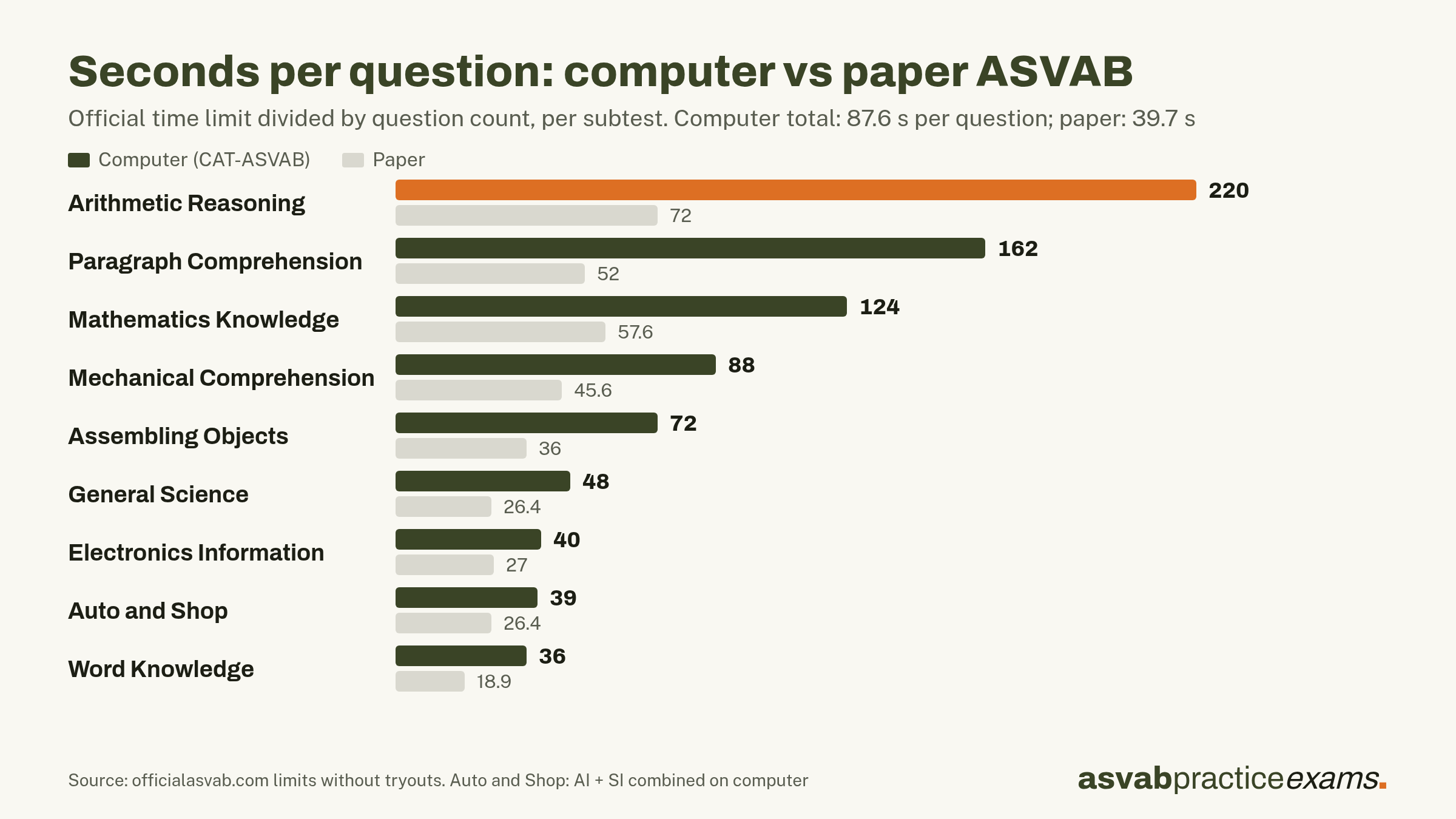
The subtests come in this order on test day. The seconds per question are our arithmetic on the official limits (officialasvab.com, ASVAB Fact Sheet).
| Subtest | Computer: questions | Computer: minutes | Computer: seconds per question | Paper: questions | Paper: minutes | Paper: seconds per question |
|---|---|---|---|---|---|---|
| General Science (GS) | 15 | 12 | 48 | 25 | 11 | 26.4 |
| Arithmetic Reasoning (AR) | 15 | 55 | 220 | 30 | 36 | 72 |
| Word Knowledge (WK) | 15 | 9 | 36 | 35 | 11 | 18.9 |
| Paragraph Comprehension (PC) | 10 | 27 | 162 | 15 | 13 | 52 |
| Mathematics Knowledge (MK) | 15 | 31 | 124 | 25 | 24 | 57.6 |
| Electronics Information (EI) | 15 | 10 | 40 | 20 | 9 | 27 |
| Auto Information (AI) | 10 | 7 | 42 | 25 (one combined Auto and Shop subtest) | 11 | 26.4 |
| Shop Information (SI) | 10 | 6 | 36 | |||
| Mechanical Comprehension (MC) | 15 | 22 | 88 | 25 | 19 | 45.6 |
| Assembling Objects (AO) | 15 | 18 | 72 | 25 | 15 | 36 |
| Total | 135 | 197 | 87.6 | 225 | 149 | 39.7 |
Two patterns matter for how you prepare:
- The computer test gives you more than twice the time per question overall, 87.6 seconds against 39.7. It can afford to, because it asks fewer questions.
- The clock is not shared out evenly. Arithmetic Reasoning gets 220 seconds a question because word problems need setup. Word Knowledge gets 36, so on test day you either know the word or you don’t. Paragraph Comprehension gets 162, time to check each answer against its passage (how to answer each PC question type). Mechanical Comprehension gets 88, enough to sketch a lever or count gear meshes (the rules that solve most MC questions).
Older guides still list 145 questions and 154 minutes for the computer test. The current official table is 135 scored questions and 197 minutes.
The four AFQT subtests are 55 of the 135 questions. Arithmetic Reasoning, Word Knowledge, Paragraph Comprehension and Mathematics Knowledge decide whether you can enlist, and their limits add up to 122 minutes. Our guide to the AFQT score shows how those four combine. The other six subtests count only toward the line scores that qualify you for jobs.
Why the computer ASVAB has fewer questions
The paper test gives everyone the same questions, so it has to include very easy and very hard ones to measure every ability level. The computer test picks each next question from a pool based on your answers so far: get one right and the next is usually harder, get one wrong and it is usually easier. Matching the questions to you measures your ability precisely with fewer of them (officialasvab.com).
That also means the computer test can feel harder if you are doing well. You see fewer easy questions. Scores on the two versions are statistically linked, so you would be expected to get a similar score on either (officialasvab.com FAQ).
Tryout questions: why you may see more than 135
On the proctored computer test, 2 to 4 of your subtests also carry tryout questions: new questions being tested that do not count toward your score. The official table lists 15 possible tryout questions per subtest, mixed in with the scored ones, and gives a longer time limit when they appear. Arithmetic Reasoning, for example, goes from 55 to 113 minutes (officialasvab.com).
So the number you see on screen can be as high as 195: 135 scored plus 15 in each of 4 subtests. You cannot tell which questions are tryouts, so treat every one as scored.
How long the ASVAB actually takes
| Version | Where | Time limit | What it usually takes |
|---|---|---|---|
| CAT-ASVAB (computer, proctored) | MEPS or a satellite test site | 197 minutes without tryouts | About 2 hours on average; you move on as soon as you finish a subtest |
| Paper ASVAB | A handful of satellite test sites | 149 minutes of testing | 3 to 4 hours including instructions and paperwork |
| PiCAT (computer, unproctored) | Anywhere with a computer and internet | No subtest time limits; finish within 48 hours of starting | 2 to 3 hours, plus, if your scores qualify, a 25 to 30 minute verification test at MEPS or a test site within 45 days |
Sources for every row: officialasvab.com. The PiCAT is only for people who have never taken the ASVAB, can be taken once, and needs an access code from a recruiter.
A clock check for every subtest
On the computer test, the time remaining and the questions remaining for the subtest are shown in the lower-right corner of the screen (same source). The table turns each official limit into the time that display should still show after questions 5 and 10 if you work at an even pace. On a subtest that carries tryout questions, you get the longer limit instead (113 minutes for Arithmetic Reasoning).
| Subtest | Limit | Clock after question 5 | Clock after question 10 |
|---|---|---|---|
| General Science | 12:00 | 8:00 | 4:00 |
| Arithmetic Reasoning | 55:00 | 36:40 | 18:20 |
| Word Knowledge | 9:00 | 6:00 | 3:00 |
| Paragraph Comprehension (10 questions) | 27:00 | 13:30 | 0:00 (subtest done) |
| Mathematics Knowledge | 31:00 | 20:40 | 10:20 |
| Electronics Information | 10:00 | 6:40 | 3:20 |
| Auto Information (10 questions) | 7:00 | 3:30 | 0:00 (subtest done) |
| Shop Information (10 questions) | 6:00 | 3:00 | 0:00 (subtest done) |
| Mechanical Comprehension | 22:00 | 14:40 | 7:20 |
| Assembling Objects | 18:00 | 12:00 | 6:00 |
These are checkpoints, not targets. The official guidance is that the limits are liberal enough that nearly everyone finishes each subtest (officialasvab.com). If you are well behind a checkpoint, pick up your pace so you reach every question instead of leaving any unanswered.
Never let the computer clock run out. Questions you have not answered when time expires are scored as though you had answered them at random ([officialasvab.com](https://www.officialasvab.com/applicants/cat-asvab/)). On paper there is no guessing penalty, so fill in a guess for anything left in the last minute ([ASVAB Fact Sheet](https://www.officialasvab.com/wp-content/uploads/2026/10/ASVAB-Fact_Sheet.pdf)).
Two questions from our practice exams, against the clock
These show what the two ends of the per-question clock feel like. Both are live questions in our free practice exams.
Arithmetic Reasoning: what 220 seconds is for
How many square tiles, each 6 inches on a side, are needed to cover a floor that is 10 feet by 12 feet?
A. 20 · B. 120 · C. 240 · D. 480
Answer: D. A 6-inch tile is 1/2 foot by 1/2 foot, so it covers 1/4 square foot. The floor is 10 × 12 = 120 square feet, and 120 ÷ 1/4 = 480 tiles. C is the trap: it treats a tile 1/2 foot on a side as covering 1/2 square foot. B stops at the floor area, and A divides by 6 without changing inches to feet.
This is three steps (convert, find the area, divide) and the conversion is where points are lost. The 220 seconds exist for exactly this: use some of them to write the units on your scratch paper, because there is no calculator on the ASVAB (officialasvab.com). This question is in Practice Exam 2, Arithmetic Reasoning. The Arithmetic Reasoning practice test has a stopwatch that shows your seconds per question and marks it against the paper test’s 72 seconds, a stricter pace than this one.
Word Knowledge: what 36 seconds is for
Impartial most nearly means:
A. strict · B. neutral · C. impatient · D. prejudiced
Answer: B. Impartial means not favoring one side, which is what neutral means. C only sounds like it. D is the opposite. A is the tempting one: a fair judge is often strict, but a strict judge can still take sides.
At 36 seconds there is no time to reason from scratch. You recognize the word, or you use a word part (im- means not, partial means taking a part or a side) and eliminate fast. This question is in Practice Exam 3, Word Knowledge.
How many times you can take the ASVAB
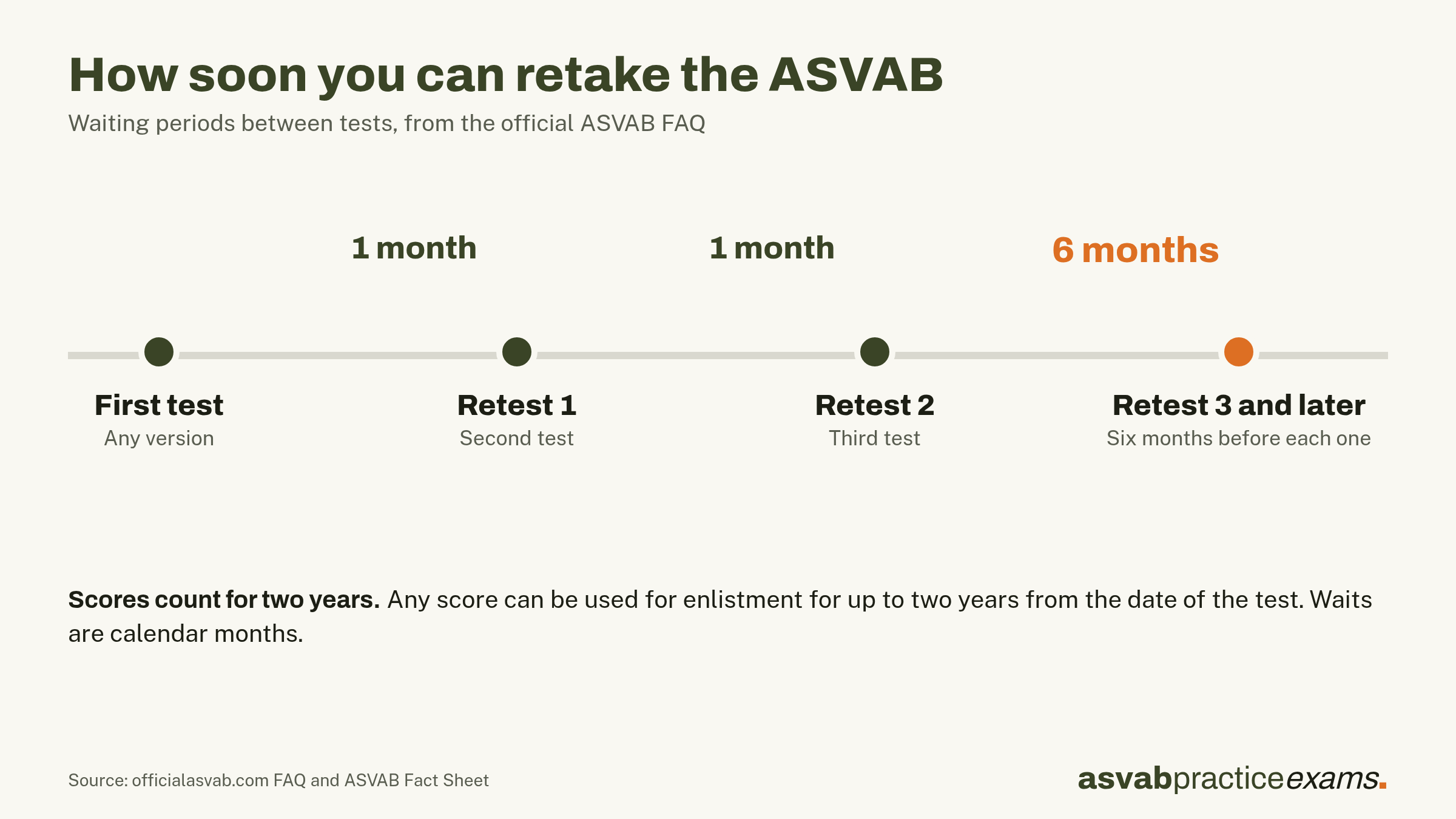
The official retest rule has three steps (officialasvab.com FAQ):
- After your first ASVAB, wait one calendar month to retest.
- After that retest, wait another calendar month to test a second time.
- After that, wait six calendar months before each retest (ASVAB retest policy).
Your scores can be used for enlistment for up to two years from the test date (officialasvab.com FAQ). The six-month wait starts after your second retest, which is your third test. Before you book a retest, check the score you need for your goal, from the diploma minimum to the GED line.
Practice at the real length
Each of our four practice exams has the official computer counts and limits: 135 questions in all 10 subtests with up to 197 minutes, one question per screen, a separate clock for each subtest, and the same rule for questions left when time runs out. An AFQT-only mode runs just the four AFQT subtests, 55 questions in up to 122 minutes.
- Start with a full timed run. Switch Study mode off for real exam conditions. Practice Exam 1 shows whether any subtest timed out on you before you sit the real test.
- Retake on a new set. Exams 2 and 3 share no questions with Exam 1 and follow the same topic mix with a near-identical difficulty spread (how the exams are built), so a second timed run measures your pacing, not your memory.
- Use the clock check. Note where you are after questions 5 and 10 in each subtest and compare with the table above.
Our question bank holds 654 original questions, from 76 each in Word Knowledge, Electronics Information and Mechanical Comprehension to 40 in Shop Information. Two subtests also have a practice page of their own with every question in the bank: the Arithmetic Reasoning practice test and the General Science practice test, where you can time yourself against the paper pace from the table above (about 26 seconds a General Science question). More short guides are on the study guide page.
Frequently asked questions
How long is the ASVAB test?
The computer ASVAB has time limits that add up to 197 minutes, but most people finish well before that: officialasvab.com puts the average at about 2 hours, and the ASVAB Fact Sheet says about 1 1/2. The paper ASVAB has 149 minutes of testing time and takes 3 to 4 hours in all once instructions and paperwork are included.
How many questions are on the paper ASVAB?
225 questions in nine subtests, with 149 minutes of testing time. Auto and Shop Information are one combined subtest of 25 questions on paper. The paper version is given at only a handful of satellite test sites.
How many times can you take the ASVAB?
After your first test you wait one calendar month to retest, then another calendar month before a second retest. After that, each retest needs a six calendar month wait. Your scores can be used for enlistment for up to two years from the test date.
Do tryout questions count toward my score?
No. On the computer test, tryout questions are new questions being tested for future use, and they are mixed in with the scored ones in 2 to 4 subtests. You get extra time when they appear, but you cannot tell which questions they are, so answer every question as if it counts.
How many questions are on the AFQT part of the ASVAB?
On the computer ASVAB, 55: Arithmetic Reasoning (15), Word Knowledge (15), Paragraph Comprehension (10) and Mathematics Knowledge (15), with time limits adding up to 122 minutes. The AFQT is not a separate test; it is computed from those four subtests.
Built and maintained by the ASVAB Practice Exams team. Every question is original, written to a subtest blueprint drawn from the official samples and DoD technical reports, and checked by a second reviewer who answers it without the key. About this site →