ASVAB Mechanical Comprehension: The Principles Tested and How to Solve Each Type
Last updated: November 15, 2026
ASVAB Mechanical Comprehension (MC) gives you 15 scored questions in 22 minutes on the computer test, about 88 seconds each. The paper test has 25 questions in 19 minutes. No calculator is allowed on either (officialasvab.com).
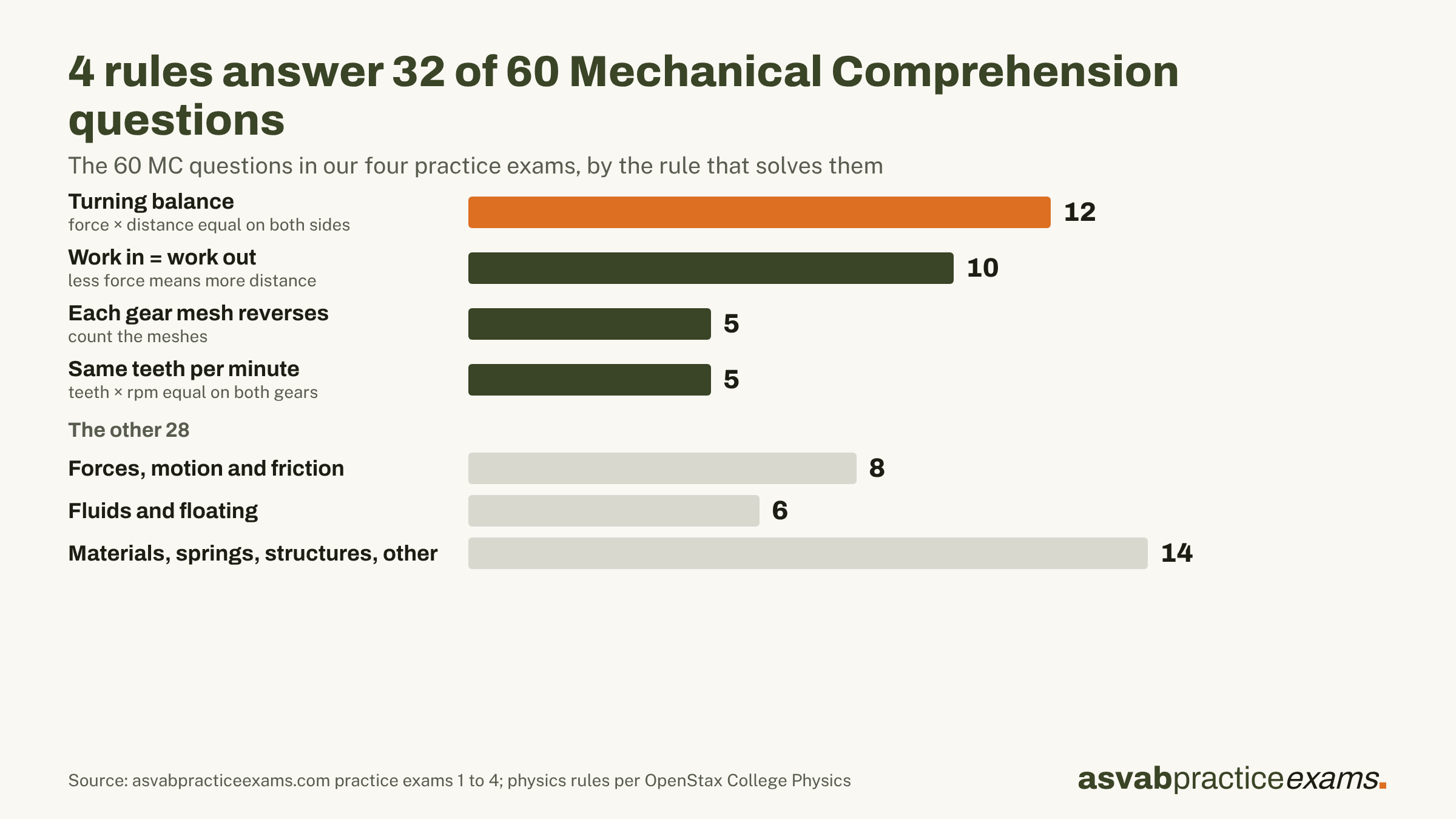
MC looks like a physics test, but most of it runs on a few rules. We sorted the 60 MC questions in our four practice exams by the rule that solves them. Four rules answer 32 of the 60. This guide gives each rule, the traps in the wrong answers, and three questions from our practice exams worked step by step.
What Mechanical Comprehension measures
The official description is “knowledge of mechanical and physical principles” (officialasvab.com). The ASVAB Career Exploration Program spells it out: the principles of mechanical devices, structural support, and properties of materials, with topics that include simple and compound machines, mechanical motion and fluid dynamics (ASVAB CEP Technical Summary).
The five official samples show the range: where a crane’s center of gravity moves, which way friction acts on a skier, why a pump valve opens, which shelf holds the most, and what kind of gear set is shown (officialasvab.com).
MC does not count toward your AFQT. It counts toward job qualification. By our count it is a main input in 12 of the 28 service composites, including the Air Force Mechanical score and the Marine Corps GT score, and the Army’s weighted composites give it some weight in all nine. Our guide to ASVAB line scores shows the formulas. General Science, another subtest outside the AFQT, uses some of the same physics: the General Science practice test has force, work, energy and momentum questions worked with the formula.
What our 60 practice questions cover, and the rule for each
Each of our four practice exams has 15 MC questions, the same count as the computer test. The official test does not publish its topic mix, so we built ours from the official content list and the published test specifications (how the exams are built). Treat it as a close guide, not a promise.
| Category | Of our 60 | The rule that solves most of them |
|---|---|---|
| Gears, belts and cams | 12 | Each mesh reverses direction. Teeth × rpm is the same on both gears. |
| Levers | 8 | Force × distance from the pivot is equal on both sides. |
| Fluids and buoyancy | 8 | Pressure spreads evenly in a closed fluid. A floating object pushes aside its own weight of water. |
| Forces and motion | 8 | Newton's laws: nothing changes speed or direction without a force. Friction opposes the motion. |
| Structures and stability | 8 | The closer support carries more of the load. A low, wide base is harder to tip. |
| Pulleys | 4 | Force = load ÷ number of strands holding the moving block. |
| Ramps, screws, wheel and axle | 4 | Force × distance moved = load × height raised. |
| Work, energy and springs | 4 | Work = force × distance. Spring stretch grows in step with the load. |
| Materials and heat | 4 | Heat makes materials expand, and some expand more than others. |
Gears, belts and cams lead because they come in two kinds: which way a part turns, and how fast. Every exam has 3 of them.
The four rules that answer 32 of the 60
1. Turning balance (12 questions)
A lever, a beam on two posts, or a wheel on an axle balances when force × distance from the pivot is the same on both sides (OpenStax College Physics).
Example from Practice Exam 1: a 120 lb load sits 2 ft from the fulcrum, and you push 6 ft out on the other side. 120 × 2 = 240, and 240 ÷ 6 = 40 lb. The long side always needs less force.
For two supports, flip the logic: the support closer to the load carries more of it. A 300 lb load 4 ft from support A and 8 ft from support B puts 200 lb on A.
2. Work in equals work out (10 questions)
Pulleys, ramps, screws and hydraulic lifts cut the force you need, but you pay in distance. Ignoring friction, force × distance going in equals force × distance coming out (OpenStax College Physics).
Example from Practice Exam 4: four rope strands hold up a load. Each strand has to shorten by 3 ft to raise it 3 ft, so you pull 4 × 3 = 12 ft of rope, with one fourth of the force.
Check the trade. If an answer gives you less force and less distance, it is wrong. A machine can save force or distance, never both.
3. Each gear mesh reverses direction (5 questions)
Two meshed gears turn in opposite directions. In a line of gears, the 1st, 3rd and 5th turn the same way and the 2nd and 4th turn the other way. A crossed belt reverses direction too; an open belt does not.
Count the meshes, not the gears. An odd number of meshes reverses the direction, and an even number keeps it.
4. Same teeth, or same belt, per minute (5 questions)
Where two gears mesh, the same number of teeth pass each minute. So teeth × rpm is equal on both gears. For belts and chains, use diameter × rpm, or sprocket teeth × rpm.
Example from Practice Exam 2: a 10 in pulley at 300 rpm drives a 4 in pulley. 300 × 10 = 3,000, and 3,000 ÷ 4 = 750 rpm. The smaller wheel always turns faster.
The other 28: one line each
- Fluids (6). A floating object pushes aside water equal to its own weight (OpenStax). Water pressure grows with depth. Water speeds up where a pipe narrows.
- Forces, motion and friction (8). A moving object keeps going straight until a force acts. Friction points against the sliding. Starting a crate takes more force than keeping it moving.
- Materials and heat (4). Metal expands when heated. A strip of two metals bends toward the one that expands less.
- Springs, work and power (4). Double the load, double the stretch. Power is work divided by time.
- Structures (4). A triangle frame cannot change shape; a square one can fold. A sagging beam is squeezed on top and stretched underneath.
- Two more: one cam question and one on the three lever classes.
Hydraulics belongs to rule 2 but needs one more idea: pressure is the same on both pistons, so force grows with piston area (OpenStax). The first worked question below turns on exactly that.
Three questions from our practice exams, worked through
These questions appear in our practice exams. Try each one before reading the answer.
Hydraulics: from Practice Exam 4
In a hydraulic lift, the small piston is 2 in across and the large piston is 6 in across. A 30-lb force pushes on the small piston. Ignoring friction, how much force does the large piston push up with?
A. 10 lb · B. 90 lb · C. 180 lb · D. 270 lb
Answer: D. Pressure is equal on both pistons, so force grows with area. Area grows with the diameter squared. The diameters differ by 6 ÷ 2 = 3, so the areas differ by 3 × 3 = 9. Then 30 × 9 = 270 lb.
- B is the trap most people fall into: it multiplies by the diameter ratio, 3, and forgets that area is squared.
- A divides instead of multiplying. The big piston always pushes harder.
- C multiplies the force by the large diameter, 30 × 6, which is not a pressure relationship.
This question is in Practice Exam 4, Mechanical Comprehension.
Gear speed with an idler: from Practice Exam 1
Gear A (10 teeth) turns at 90 rpm. It drives gear B (30 teeth), which drives gear C (15 teeth). How fast does gear C turn?
A. 30 rpm · B. 60 rpm · C. 90 rpm · D. 135 rpm
Answer: B. Use rule 4. Gear A pushes 90 × 10 = 900 teeth a minute through every mesh. Gear C has 15 teeth, so it turns 900 ÷ 15 = 60 rpm. Gear B in the middle is an idler: it changes the direction, not the overall speed ratio.
- A is the speed of gear B (900 ÷ 30), the right number for the wrong gear.
- C assumes an idler means C matches A. It would only if C had 10 teeth like A.
- D runs the ratio backwards. The gear with more teeth turns slower.
This question is in Practice Exam 1, Mechanical Comprehension.
Three gears in a loop: from Practice Exam 3
Gears A, B, and C each mesh with the other two. What happens when someone tries to turn gear A clockwise?
A. The gears jam and cannot turn · B. Gear C turns clockwise · C. Gear C turns counterclockwise · D. Gears B and C turn counterclockwise
Answer: A. Use rule 3. A clockwise forces both B and C counterclockwise. But B and C also mesh with each other, and two meshed gears must turn opposite ways. They cannot both be right, so the gears lock.
- C and D are what you get by checking only the meshes with A. Always check every pair.
- B breaks the basic rule: a gear meshed with A cannot turn the same way as A.
A closed loop of an odd number of gears always jams. This question is in Practice Exam 3, Mechanical Comprehension.
How to use the 22 minutes
At 88 seconds a question, the computer test gives you about twice the time of the paper test, which allows about 46 (our arithmetic on the official limits). Our guide to how many questions are on the ASVAB has a clock check for every subtest.
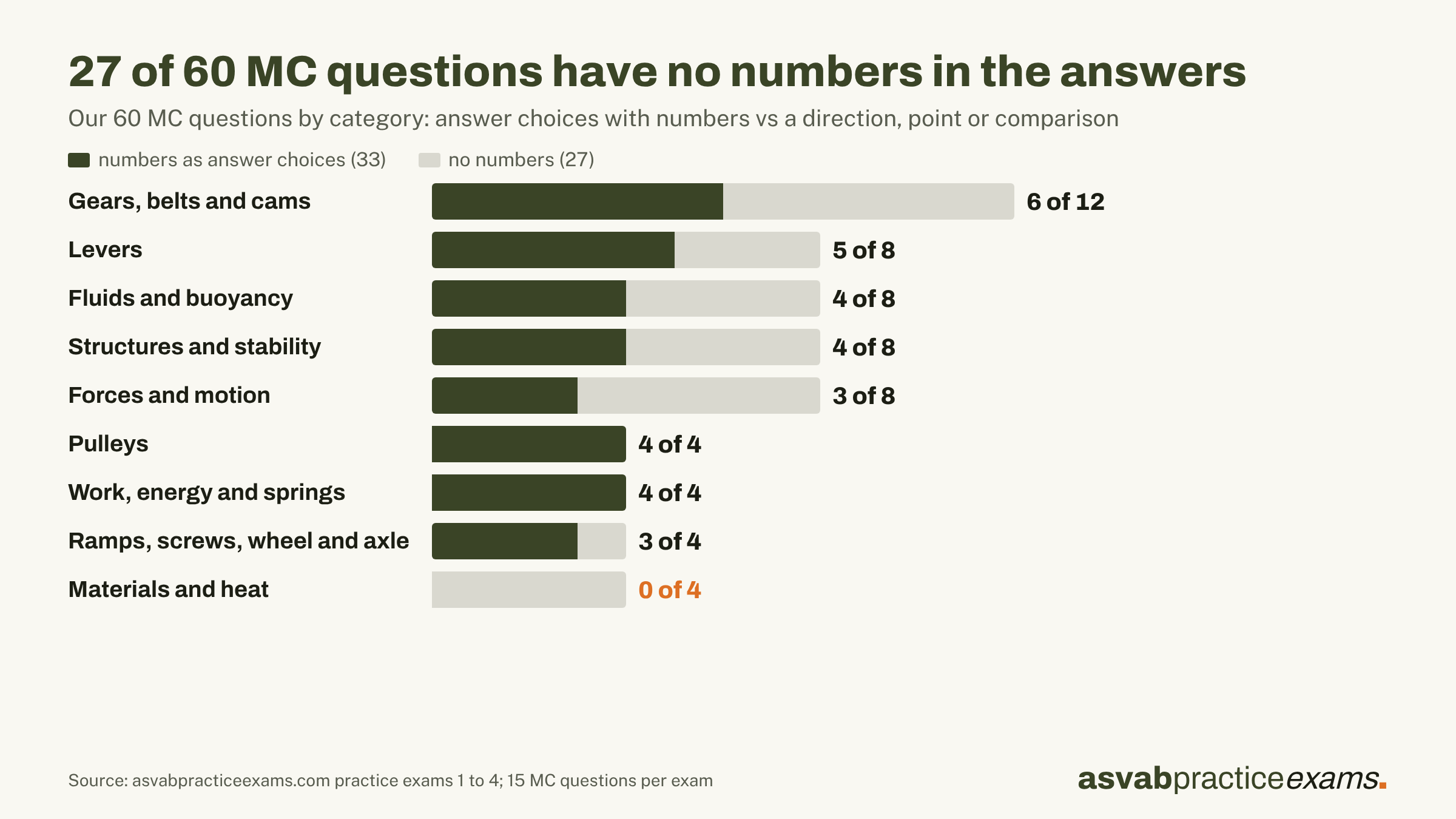
Only 33 of our 60 MC questions have numbers as answer choices. The other 27 ask for a direction, a point on a drawing, or a comparison. Those can be fast, so bank the time for the ones that need arithmetic.
- Look at the drawing first. Find the pivot, the meshes or the strands before you read the choices.
- Name the rule. Turning balance, work trade, mesh direction, equal teeth, or one of the others.
- Estimate. Will the answer be bigger or smaller than the force you start with? Faster or slower? That alone usually rules out two choices.
- Then calculate. With no calculator allowed, expect numbers that work out by hand.
Watch the backwards ratio. Many gear, pulley and lever questions offer a wrong answer that runs the ratio backwards, multiplying where you should divide, like choice D in the idler gear question above. Your estimate in step 3 catches it.
Practice Mechanical Comprehension at the real clock
Each of our four practice exams has 15 MC questions in 22 minutes, with a drawing where the question needs one and an explanation for every answer choice.
- Start with a timed run of Practice Exam 1 with Study mode off, then sort every MC miss by the rule it needed.
- Look for a pattern. Misses on gears and pulleys usually mean a flipped ratio. Misses on levers and supports usually mean measuring from the wrong point.
- Retake on a new set. Practice Exam 2 and the other exams share no questions with Exam 1.
If you are aiming at a mechanical job, check which composites your branch uses in the line scores guide. More short guides are on the study guide page.
Frequently asked questions
How many Mechanical Comprehension questions are on the ASVAB?
The computer ASVAB has 15 scored Mechanical Comprehension questions with a 22 minute limit, about 88 seconds each. The paper ASVAB has 25 questions in 19 minutes, about 46 seconds each. Some computer test takers also see unscored tryout questions, with extra time to match.
Can you use a calculator on the Mechanical Comprehension subtest?
No. The official rule is that you cannot use a calculator on any part of the ASVAB. Scratch paper is provided ([officialasvab.com](https://www.officialasvab.com/recruiters/cat-asvab/)). Expect numbers that work out by hand.
Is Mechanical Comprehension part of the AFQT?
No. The AFQT uses only Word Knowledge, Paragraph Comprehension, Arithmetic Reasoning and Mathematics Knowledge. Mechanical Comprehension counts toward the line scores that qualify you for jobs, including the Air Force Mechanical score, the Marine Corps GT score and several Army and Navy composites.
What formulas do I need for ASVAB Mechanical Comprehension?
Four rules answer 32 of the 60 MC questions in our practice exams: force times distance is equal on both sides of a pivot, work in equals work out, each meshed gear reverses direction, and teeth times rpm is the same on two meshed gears. Add Pascal's principle for hydraulics and Archimedes' principle for floating objects.
How can I improve my Mechanical Comprehension score?
Learn to name the rule a question needs before you calculate anything. Then estimate the answer's size and direction, which rules out most wrong choices. Practice under the real clock: 15 questions in 22 minutes.
Built and maintained by the ASVAB Practice Exams team. Every question is original, written to a subtest blueprint drawn from the official samples and DoD technical reports, and checked by a second reviewer who answers it without the key. About this site →